
Independent financial advisor or bank advisor? Differences, liability and conflicts of interest
This guide refers to German law and the German tax system. It is a translation of our German original and does not replace individual tax or legal advice.
Anyone who wants to invest money, provide for retirement or finance a property often ends up at their own bank first. The alternatives are independent financial advisors, brokers and fee-based advisors. This comparison shows objectively where the differences lie – legally, in remuneration and in liability.
Who is who? The types of advisor at a glance
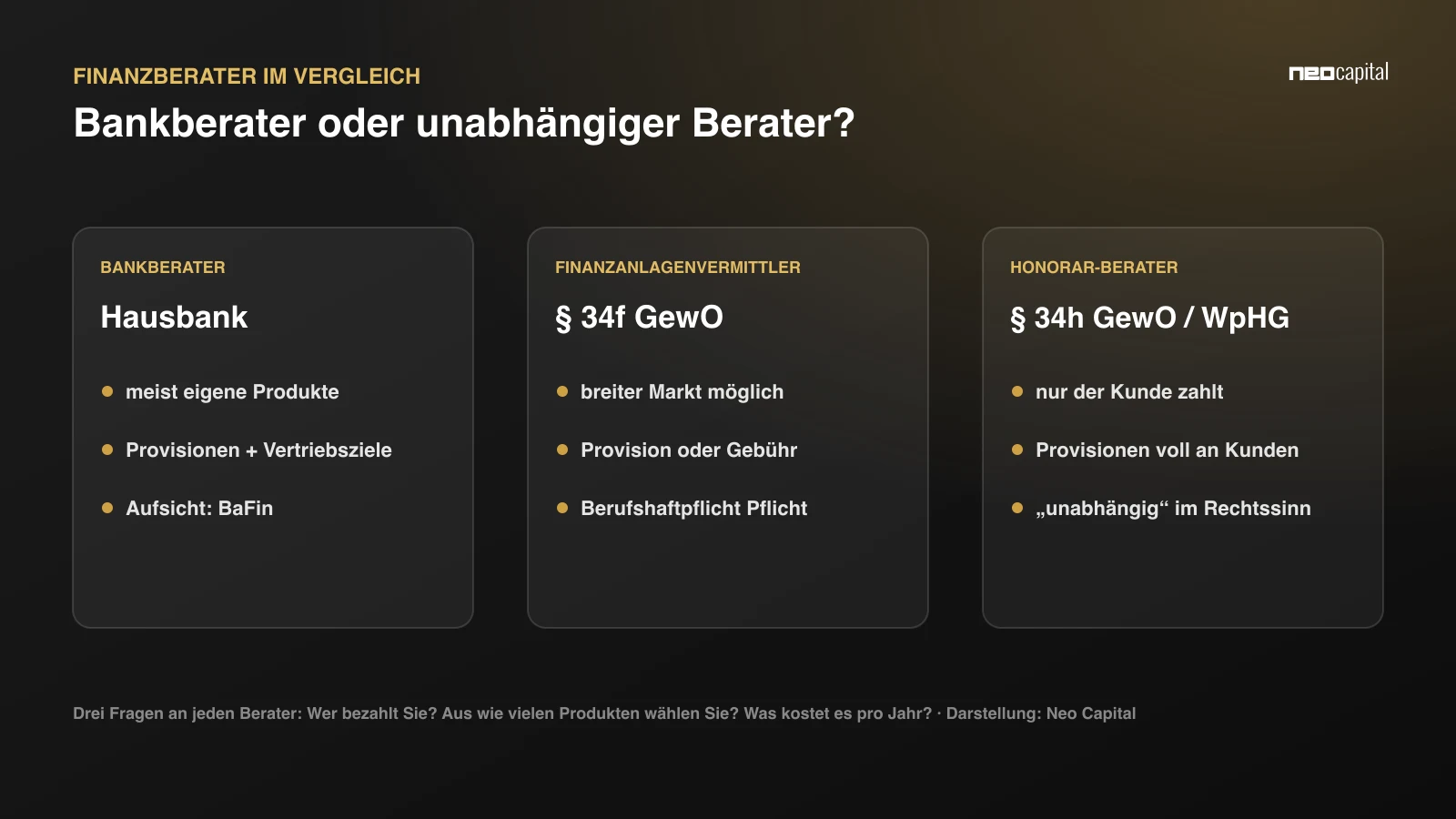
| Bank advisor | Financial investment intermediary (Section 34f GewO) | Fee-based advisor (Section 34h GewO / Section 64(5) WpHG) | |
|---|---|---|---|
| Product selection | mostly own products and partners | broad market or restricted – must be disclosed | sufficiently broad market, not limited to own products |
| Paid by | commissions, margins, fees | commissions (to be disclosed) and/or fees from the client | exclusively the client |
| Commissions | permitted if disclosed and quality-enhancing | permitted if disclosed | only if no commission-free product exists – then passed on in full to the client |
| Supervision | BaFin | trade office (Berlin: district office), register at the IHK (Chamber of Industry and Commerce) | BaFin (Section 93 WpHG) or trade office (Section 34h) |
| Liability | bank as institution | intermediary, mandatory professional indemnity insurance | advisor or institution, mandatory professional indemnity insurance (Section 34h) |
What "independent" means legally
In everyday language, many advisors call themselves independent because they are not tied to a bank. Legally, the term is narrower: independent fee-based investment advice (unabhängige Honorar-Anlageberatung) must consider a sufficient range of products on the market, may only be paid for by the client and may only accept commissions if there is no equivalent product without commission – and must then pass them on to the client immediately and in full (Section 64(5) WpHG). Only firms entered in the corresponding BaFin register may use the designation (Section 94 WpHG).
For independent advisors with a trade licence there is the counterpart: the Honorar-Finanzanlagenberater (fee-based financial investment advisor) under Section 34h GewO. He may not keep any inducements from product providers. Anyone holding this licence cannot at the same time act as a commission-eligible financial investment intermediary (Finanzanlagenvermittler) under Section 34f – the two licences are mutually exclusive. Before the first advice, every advisor must disclose under which licence he works (Section 12 FinVermV) or whether he advises independently (Section 64(1) WpHG).
Conflicts of interest: how bank advisors are paid
Banks earn from commissions, front-end loads and margins on their own products. Sales targets for advisors are permitted but must not be at the expense of clients – this is what BaFin requires in its minimum requirements for compliance (MaComp). Commissions are only permitted if they improve the quality of the service and are disclosed in advance (Section 70 WpHG). A similar rule also applies to financial investment intermediaries (Section 17 FinVermV).
A conflict of interest does not mean that the advice has to be bad. It does mean, however, that you should examine recommendations critically – especially with in-house funds, high front-end loads and frequent switching.
What tests and studies show about bank advice
- BaFin mystery shopping 2023: In covert test consultations by BaFin, clients received no suitability statement (Geeignetheitserklärung) in 40% of the meetings and no cost information in advance in 67% (BaFin annual report 2023). The sample is not representative, and because no orders were placed, the suitability statement was not mandatory in every case – BaFin nevertheless saw a need for improvement.
- BaFin mystery shopping at insurers 2024: In 72 advisory meetings on unit-linked insurance at six insurers, suitability was documented in only about half of the cases (BaFin, 17 June 2025).
- Stiftung Warentest: In the last major test of investment advice (160 consultations at 23 banks), only three banks were rated "good"; the testers attributed the errors to commission-driven sales targets rather than a lack of competence (Finanztest 02/2016).
- Research: A study using data from German bank and broker clients found lower net returns, poorer risk-return ratios and more trading in advised portfolios – more pronounced with bank advisors than with independent advisors (Hackethal, Haliassos and Jappelli 2012).
The study also shows: advice in itself is no panacea. What matters are costs, discipline and a strategy that suits you. What good advice can measurably achieve is shown on our page Is a financial advisor worth it? (in German).
Liability: who is responsible for mistakes?
- Bank: Is liable as an institution for advisory errors by its employees.
- Financial investment intermediaries and Honorar-Finanzanlagenberater: Need professional indemnity insurance for their licence (Section 34f(2) GewO) with minimum cover of currently €1,276,000 per claim and €1,919,000 per year (Section 9 FinVermV), plus a certificate of expertise from the IHK.
- Limitation period: Claims for mis-selling generally become time-barred three years from the end of the year in which you learned or should have learned of the error – but at the latest ten years after the damage arose (Sections 195, 199 BGB).
- Documentation: Before a securities purchase following advice, you receive a suitability statement (Geeignetheitserklärung) explaining why the recommendation suits you (Section 64(4) WpHG, Section 18 FinVermV). In 2018 it replaced the former advisory record. Keep it – in the event of a dispute it is your most important piece of evidence.
A fee is no seal of quality: what really matters
The remuneration model says something about possible conflicts of interest – but nothing about whether an advisor knows their craft. A fee-based advisor can put together a low-cost, clean ETF portfolio and still fail at what determines your result: the strategy, the tax structure and keeping you from selling in the next crisis. Conversely, a commission-paid advisor with more knowledge, experience and discipline can in theory achieve better results for clients than a fee-based advisor.
How big this lever is, is shown by research: on average, investors earn around 1.1 percentage points per year less than the funds they invest in – because they buy after price rises and sell after losses (Morningstar, Mind the Gap 2024). This gap is often larger than any difference in advisory costs.
Typical situations from practice
- The low-cost portfolio that is sold in the crash: Costs are low, the products good – but in the market slump there is no contact person to explain the strategy. Selling at the low point costs more than any fee ever could have.
- Severance pay in the wrong year: Whether severance pay is received in the year of leaving or the following year, and how it is combined with pension contributions or investments, can make a difference of five-figure tax amounts. That requires expertise, not just a remuneration model (Receiving severance pay tax-efficiently).
- The property without the overall picture: An investment flat can be excellent for tax purposes or become a burden – depending on financing, depreciation, income and exit plan. Anyone who only assesses a product does not see the overall picture (Building a property portfolio strategically).
In the end it is about more than percentages: about your retirement, your family's security, often the result of an entire working life. For that you need someone you trust even when markets get nervous – and who then tells you honestly what to do and what not to do.
Five criteria that say more than the remuneration model
- Training and specialisation: What additional qualifications does the advisor have beyond the statutory expertise? What topics does he specialise in – for example entrepreneurs, real estate, severance pay, retirement provision?
- Long track record: How long has he been advising, and has he guided clients through real crises, such as the Covid crash in 2020 or the interest rate year 2022? Ask specifically what he advised his clients at the time.
- Verifiable client results: Ask to see anonymised examples – portfolio histories, transactions, results after costs compared with a suitable benchmark. Anyone who does good work can prove it.
- Genuine reviews: Look for many verifiable reviews over several years, for example on Google – not individual success stories.
- Financial stability of the advisor: An advisor who is financially sound and lives from recurring client support rather than quick sales has no reason to pressure you. Ask how long the company has existed and how it is financed.
Good advice does not end with the portfolio
A good advisor pays attention to costs and makes scientifically sound, rational investment decisions – that is the obligation. The real added value lies elsewhere: the greatest financial potential usually does not come from fine-tuning a portfolio but from the right strategic decisions in your career, your business and your family. Vanguard, too, explicitly counts tax structure and withdrawal strategy, alongside costs and behavioural coaching, among the building blocks with which advice creates added value (Vanguard Advisor’s Alpha).
- Financial planning: Liquidity, wealth building, protection and retirement as one plan – instead of individual products side by side. More on this: Financial planning.
- Estate and wealth planning: Anyone who plans early can use allowances several times – parents can transfer up to €400,000 tax-free to each child every ten years (Section 16 ErbStG). Will, gifts and the structure of real estate belong in a joint plan (Gifts to children).
- Pointers for your tax adviser: A good financial advisor does not replace a tax adviser but recognises structuring options – for example in the timing of income, in investments or in retirement provision – and prepares them so that your tax adviser can review and implement them.
- Special situations: Severance pay, sale of a business, inheritance, separation, start-up or the transition into retirement are one-off decisions where mistakes are expensive and often irreversible.
- Thinking career, business and family together: Salary or distribution from your own GmbH, provision as a managing director, parental leave, part-time work or self-employment, buying or renting – such decisions often move considerably more money over the years than a few tenths of a percent in product costs (Retirement planning for managing directors).
How to check an advisor in two minutes
- Search the IHK intermediary register by name or registration number: it lists all intermediaries licensed under Section 34d, Section 34f, Section 34h and Section 34i GewO.
- Check banks and asset managers in the BaFin company database.
- Ask: How are you paid? How many providers do you choose from? What costs arise per year in euros?
- Have the initial information and cost breakdown given to you in writing – reputable advisors do this without being asked.
How Neo Capital works
Neo Capital is not a bank and is not tied to any product provider. We operate as a financial investment intermediary (Section 34f GewO), insurance broker (Section 34d GewO), real estate loan intermediary (Section 34i GewO) and real estate broker (Section 34c GewO). We do not hold a licence as a Honorar-Finanzanlagenberater under Section 34h GewO – and that is why we do not call ourselves one. In practice, however, we work according to comparable principles and with the same care: we choose from the broad market, disclose all remuneration and do not earn from sales or switching. All details can be found in our initial information (Erstinformation) (in German).
- Portfolio assets only for a transparent management fee: We manage securities assets exclusively as assets under management – for an openly disclosed, asset-based fee. No front-end loads or acquisition commissions are charged.
- Trail commissions to you: Depending on the agreement, we refund 100% of the trail commissions of actively managed funds to you.
- Insurance via net tariffs: We implement insurance solutions via transparent net tariffs without built-in acquisition commission.
- Purely on a fee basis on request: For complex matters – such as severance pay, wealth succession, entrepreneurs' finances or a second opinion on existing contracts – we also advise independently of products for a fee.
Our conviction: good advice comes from the combination – sound training, experience across several market cycles, verifiable results, a view beyond the portfolio to estate, taxes, business and family, a financially sound company without sales pressure, transparent remuneration with a fee option and access to the entire market. That is exactly what we want to be measured by. In a free initial consultation we will be happy to show you how we work and what our clients say about us.
What the individual remuneration models cost is shown in our article What does a financial advisor cost?. How to recognise good advice in Berlin: Finding a wealth advisor in Berlin (in German).
Frequently asked questions
What is an independent financial advisor?
In the legal sense, an independent fee-based investment advisor (BaFin register, Section 94 WpHG) or Honorar-Finanzanlagenberater (Section 34h GewO) advises from a broad range of market products and is paid exclusively by the client. In everyday language, intermediaries who are independent of banks also call themselves "independent" – so always ask about licence and remuneration.
Is a bank advisor worse than an independent financial advisor?
Not necessarily. However, bank advisors usually choose from a narrower product range and work with sales targets. Tests by BaFin and Stiftung Warentest show weaknesses in cost information and documentation. With every advisor, check costs, product selection and remuneration.
Is a fee-based advisor automatically better?
No. The fee model avoids product incentives but says nothing about expertise and experience. Also look for training, a long track record, verifiable client results, genuine reviews and an advisor who does not financially depend on quick sales.
Who is liable if a financial advisor gives me wrong advice?
With a bank, the institution is liable. Financial investment intermediaries and Honorar-Finanzanlagenberater must have professional indemnity insurance of at least €1,276,000 per claim. Claims generally become time-barred three years after knowledge, at the latest ten years after the damage arose.
How do I find out whether an advisor is licensed?
The IHK intermediary register at vermittlerregister.info lists all intermediaries licensed under Section 34d, Section 34f, Section 34h and Section 34i GewO. Banks and asset managers can be found in the BaFin company database.
What is a suitability statement (Geeignetheitserklärung)?
A document you receive before a securities purchase following advice. It explains why the recommendation suits your goals, your risk appetite and your knowledge. In 2018 it replaced the advisory record.