
Gifts to Children – How to Transfer Wealth Tax-Efficiently
This guide refers to German law and the German tax system. It is a translation of our German original and does not replace individual tax or legal advice.
A gift (Schenkung) to your own children is one of the most common ways of passing on wealth early and as tax-efficiently as possible. Through targeted strategies and by observing certain tax-free allowances, parents can give assets to their children in order to avoid high tax burdens and keep wealth within the family. Without precise planning, however, a gift can result in high taxes. This article shows how you can transfer wealth to your children tax-free and what legal structuring options exist.
For wealthy private individuals and entrepreneurs, gifts to children can be a central component of wealth planning. Neo Capital GmbH supports clients together with experienced tax advisers and notaries in structuring the process and reducing the tax burden on gifts to a minimum.
What is a lifetime gift?
A lifetime gift is a voluntary transfer of assets without consideration, governed by the German Civil Code (Bürgerliches Gesetzbuch, Sections 516 ff. BGB). It makes it possible to bypass the statutory order of succession and decide individually who should receive the assets – and since the tax-free allowances can be used again every ten years, wealth can be transferred gradually and tax-efficiently. Unlike an inheritance, which only takes effect as governed by law after the death of the testator, the donor can still influence the distribution during their lifetime and set conditions.
- Support with property financing: providing equity for your children's property purchase
- Starting a business: start-up capital for the step into self-employment
- Avoiding inheritance disputes: an early, clear distribution of assets instead of later conflicts between siblings
- Tax advantages: using the allowances for gift tax (Schenkungsteuer) for considerable savings
Tax-free allowances for gifts to children – the foundation of tax optimisation
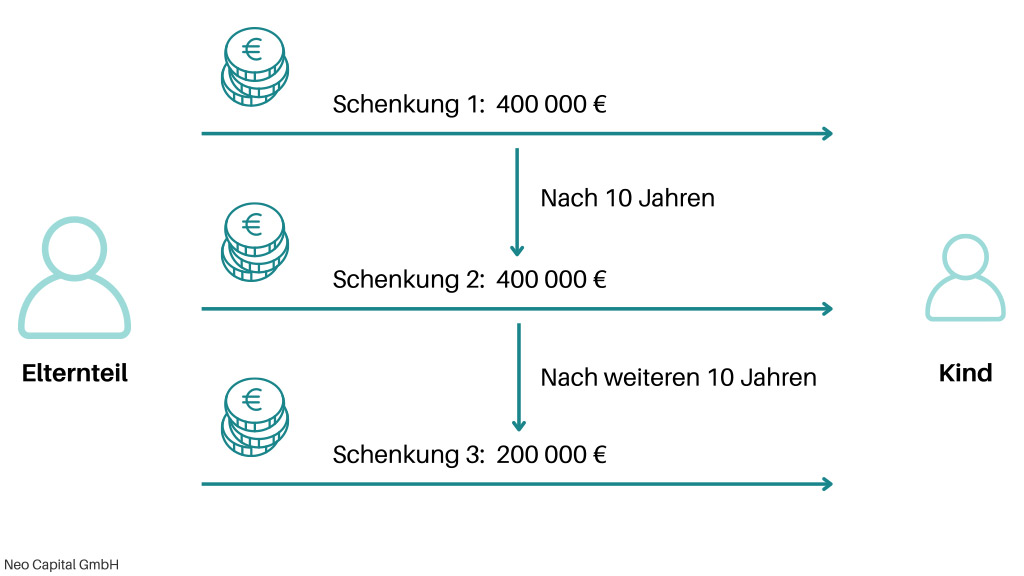
In Germany, every child has a gift tax allowance of €400,000 in respect of each parent, which can be used again every ten years. As children in tax class I benefit from lower tax rates and higher allowances, assets can be transferred tax-free step by step at regular intervals. This staggering of gifts is an effective way of passing on assets worth several million euros within the family without a tax burden. Example: if a couple wishes to transfer a property worth €800,000 to a child, it can be transferred tax-free by using both allowances (€400,000 each); if the assets exceed the allowance, half of the property can be transferred and a further gift made after ten years.
Gifting property: family home, usufruct and rights of use
Transferring an owner-occupied family home to children is possible tax-free if the child uses the property themselves and the living space does not exceed 200 square metres; if this condition is not met, gift tax is payable on the value above that. When gifting property while reserving a right of usufruct (Nießbrauch), the right of use remains with the donor, who can continue to receive rental income – the value of the usufruct reduces the assessment basis for gift tax, lowering the value of the gift to be recognised for tax purposes. A notarised gift agreement is necessary to set out the rights and obligations of the parties. In addition, rights of use and rights of revocation can be agreed: a right of revocation makes it possible to reclaim the gift under certain conditions, for example if the child sells the property, while a lifelong right of residence (Wohnrecht) allows parents to continue living in the family home even though it formally belongs to the child – and at the same time reduces the value of the gift to be recognised for tax purposes.
Tax exemption through insurance wrappers and long-term staggering of assets
A further method of tax optimisation is the insurance wrapper (Policenmantel): assets are placed in a life insurance policy, which is then passed on to the child as a gift – this not only reduces the tax burden, but also makes it possible to control the timing of the payout. In addition, long-term staggering of gifts is one of the simplest and most effective strategies: since the allowance can be used again every ten years, wealth can be transferred gradually and tax-free over decades – particularly useful for large estates, which can thus be broken down and optimally distributed among several children and beneficiaries.
Gifts to children – tax-optimised wealth planning with Neo Capital
A tax-optimised gift to children requires precise planning and expertise to make full use of the legal structuring options. Through the targeted use of allowances, the gifting of property with usufruct or the long-term staggering of wealth transfers, parents can achieve considerable tax savings and keep wealth within the family. At Neo Capital GmbH, we offer our clients professional advice and cooperation with experienced tax advisers and notaries in order to develop tailor-made gifting concepts.