
Remaining Useful Life Report for Higher Depreciation: Securing Tax Advantages through a Realistic Assessment of a Building's Lifespan
This guide refers to German law and the German tax system. It is a translation of our German original and does not replace individual tax or legal advice.
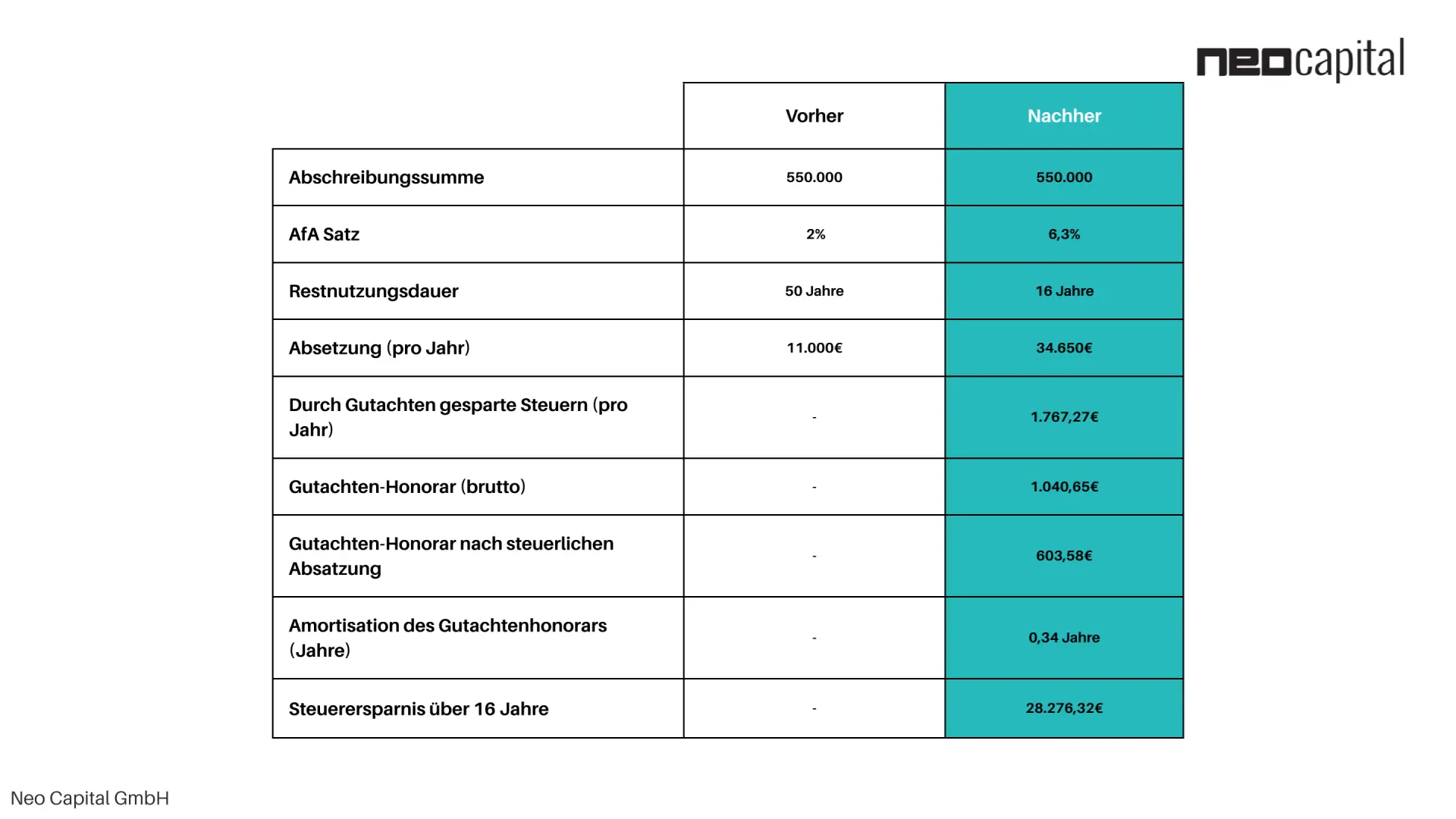
For property owners and private investors, tax depreciation for wear and tear (AfA, Absetzung für Abnutzung) is one of the key levers for optimising returns. Since the statutory reform, existing buildings in Germany are generally subject to straight-line depreciation of 2% based on a flat useful life of 50 years. Yet this flat rate often does not reflect reality, particularly for older buildings, properties in mid-market locations or properties with particular structural features. This is exactly where the remaining useful life report (Restnutzungsdauer-Gutachten) comes in: it makes it possible to demonstrate the building's actual lifespan to the tax office (Finanzamt) and thereby increase the depreciation rate significantly.
A carefully prepared report under Section 7(4) sentence 2 of the German Income Tax Act (EStG) can raise depreciation from 2% to 3%, 4% or even more, depending on how many years of remaining useful life are objectively attributed to the property. For investors, this represents a considerable tax lever: the shorter the remaining useful life, the higher the annual depreciation and the greater the liquidity advantage. The method is particularly interesting for let multi-family buildings, residential portfolios and properties that are already several decades old.
Legal basis and tax effect
Section 7(4) sentence 2 EStG expressly permits a departure from the lifespan presumed by law if the taxpayer demonstrates a shorter actual useful life. The tax office must accept this report provided it is comprehensible, technically correct and prepared by a qualified expert. The aim is to determine the actual condition and remaining lifespan of the building, not the land value or the market value. The only decisive factors are the technical wear and the structural condition of the property.
The tax effect is enormous: if a remaining useful life of, for example, 25 years is established, the AfA automatically doubles from 2% to 4%. With a remaining useful life of 20 years, the AfA is already 5%. As a result, taxable profit can be reduced by several thousand euros every year. This gives investors an immediate liquidity advantage and a noticeable increase in returns, without any building work, purely through precise documentation of the current condition.
When a remaining useful life report makes sense
A report is particularly worthwhile for older properties, unrenovated buildings or properties whose technical lifespan has been considerably reduced by previous use. For houses in mid-market or weaker locations where the state of repair is below average, the remaining useful life can also be significantly shorter than the flat 50 years. A report may even be possible for renovated buildings if the basic structure is old or structural features suggest a shortened lifespan.
The approach is especially attractive for private landlords who have to pay tax on high rental income and are looking for legal ways to reduce their ongoing tax burden. In such cases, a report can permanently lower the annual tax burden, not just for one year but over the entire remaining life of the building. The cost of the report is out of all proportion to the long-term tax advantage, which multiplies over 10, 15 or 20 years.
Tax office requirements: what a report must contain
Tax offices now scrutinise remaining useful life reports very closely. The requirements are clearly defined: the report must come from a publicly appointed or certified expert, contain a complete survey of the property and document the building fabric in a comprehensible way. This includes the condition of the roof, façade, building services, load-bearing components, damp damage and energy-related characteristics. Photographic documentation and a structural engineering assessment are also mandatory.
In addition, tax offices require a clear derivation of the remaining useful life determined. This must not be estimated or rounded but must be based on technical findings, the state of renovation and recognised valuation methods. If these requirements are met, remaining useful life reports are regularly recognised. Rejections arise almost exclusively from superficial reports or unqualified authors. A professional choice of expert is therefore crucial.
The liquidity advantage: how much tax can be saved
The effect of a remaining useful life report can be measured directly. An example: for a building with a building value of €1 million, the standard AfA of 2% results in depreciation of €20,000 per year. If, however, the remaining useful life is correctly established at 25 years, the AfA rises to €40,000 per year, an additional tax relief of €20,000 per year. At a personal tax rate of 42%, this results in a liquidity advantage of €8,400 per year.
Viewed over the entire remaining useful life, the advantage adds up to well over €100,000. For investors who use property as a long-term investment, this is a key driver of returns. As a result, many properties recoup the cost of renovations or modernisations considerably faster, as the tax relief takes effect immediately and eases the burden on ongoing income. Once prepared, a report acts as a permanent tax lever for the entire property.
Conclusion: higher AfA through a professionally determined remaining useful life – a strategic advantage
For private property investors, the remaining useful life report is one of the most effective instruments of tax planning. It creates transparency about the actual condition of the building and enables depreciation that reflects reality, often significantly higher than the statutory 2%. The resulting liquidity advantage strengthens cash flow, returns and financing capacity, and has an effect over many years.
For the report to be recognised by the tax office, experts must be selected carefully, documents provided in full and the technical condition documented precisely. Combined with a well-thought-out overall strategy, the remaining useful life report can achieve considerable tax effects and become a central component of a professional property strategy.
Frequently asked questions
How much can the AfA increase with a remaining useful life report?
Depending on the condition of the building, depreciation can rise from 2% to 3%, 4% or even 5%. The decisive factor is the technically determined remaining lifespan.
When is such a report particularly worthwhile?
For older, partially renovated or unrenovated properties, where the building fabric is heavily worn, or where there is high taxable rental income.
What does the tax office require for recognition?
A complete, comprehensible report by a certified expert with a technical survey of the property, justification of the remaining useful life and photographic documentation.
How large is the tax advantage?
Depending on the property, tax savings of several thousand euros per year can arise. Viewed over the remaining useful life, the advantages often add up to a six-figure sum.
Can the report later be challenged or disallowed?
Only if it turns out to be obviously incorrect. If it has been prepared correctly, the higher AfA remains valid over the entire remaining useful life.