
Renovation Strategy and Subsidies for Landlords: Renovate Economically, Benefit from Tax Advantages
This guide refers to German law and the German tax system. It is a translation of our German original and does not replace individual tax or legal advice.
For landlords, the energy-efficient renovation of existing properties has long ceased to be merely an option; it is a strategic necessity. Statutory requirements such as Germany's Building Energy Act (GEG, Gebäudeenergiegesetz) and the forthcoming European emissions trading system ETS-2 are increasing the pressure on owners to bring their properties up to a modern energy standard. Those who fail to act in time risk rising running costs, losses in value and falling rental income. At the same time, the state and legislators reward investors who opt for renovation early with tax advantages and extensive funding programmes.
This creates a twofold potential for landlords. On the one hand, energy-efficiency measures make properties future-proof; on the other, renovation costs can be cushioned considerably through tax instruments and subsidies. What is crucial, however, is a forward-looking strategy that gives equal weight to technical feasibility, economic sense and tax optimisation. Renovating "on demand", by contrast, carries the risk of missing opportunities or using funds inefficiently.
Why a renovation strategy is indispensable
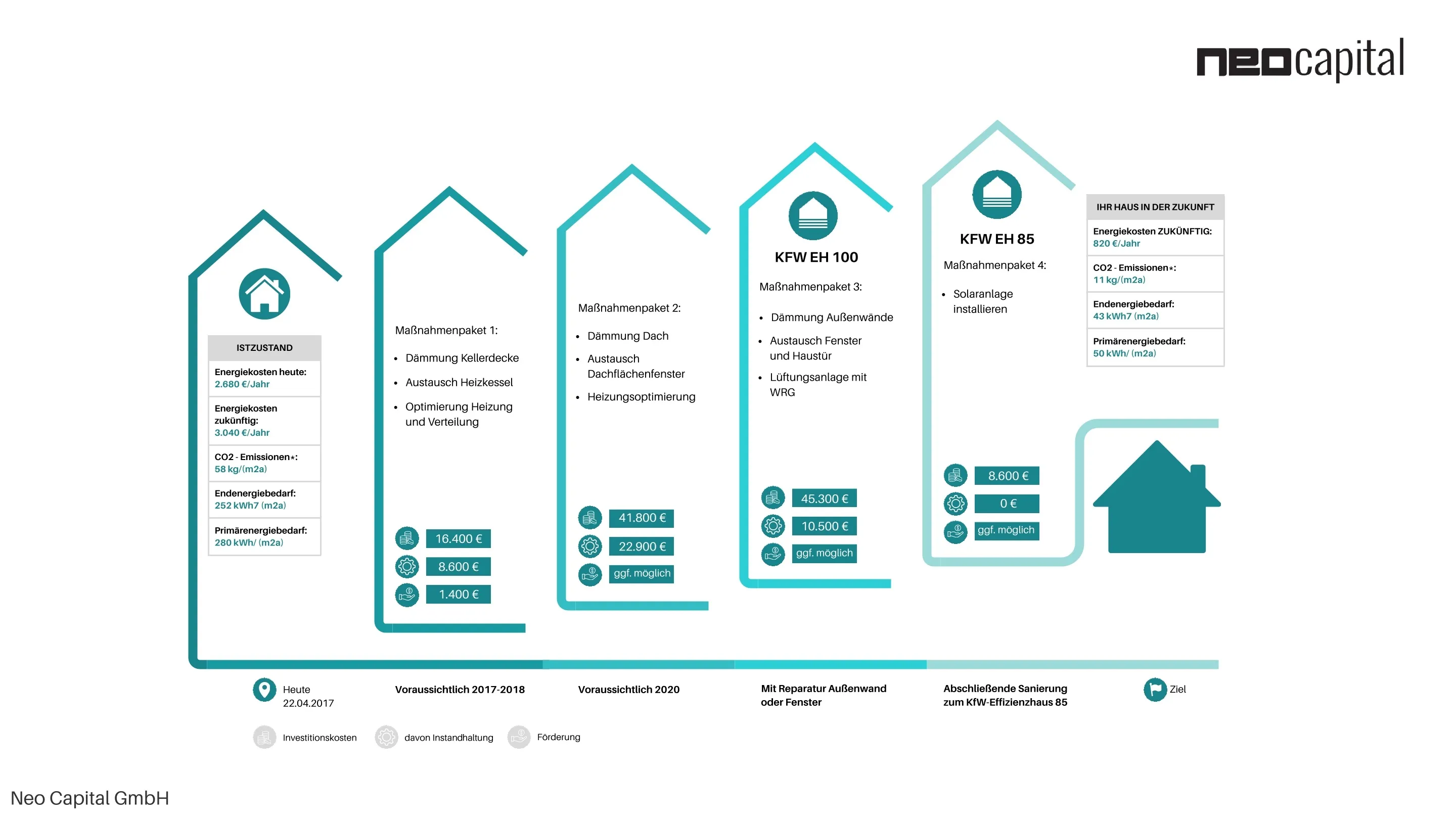
Individual measures such as replacing a heating system or insulating the façade are rarely enough to be on the safe side economically and in regulatory terms over the long term. What is needed instead is an overall concept that considers the property as a whole. Only then can measures be sensibly coordinated and implemented in a logical sequence. A well-thought-out renovation strategy ensures that investments do not have to be made twice and that all measures contribute to achieving the target energy standard.
In addition, a clear strategy gives landlords planning certainty. They know in advance what costs they will face, how these can be reduced through subsidies and over what period investments will pay for themselves. At the same time, the strategy makes it possible to involve tenants early and distribute costs fairly. This avoids conflicts and secures the property's appeal on the rental market over the long term.
Making targeted use of subsidies and tax advantages
The range of funding options for energy-efficient renovations is broad and often confusing. From KfW grants (KfW is Germany's state-owned development bank) and special tax depreciation (Sonderabschreibungen) under Section 7b of the German Income Tax Act (EStG) to regional programmes run by the federal states, landlords have numerous instruments at their disposal. A skilful combination of these resources can reduce renovation costs by a double-digit percentage. At the same time, the depreciation options can generate considerable tax effects that protect owners' liquidity.
Measures that are both eligible for subsidies and tax-advantaged are particularly attractive, such as installing energy-efficient heating systems or a comprehensive renovation to efficiency-house (Effizienzhaus) standard. Here, subsidies and tax effects work hand in hand, so investments pay for themselves significantly faster. It is important, however, to submit applications on time and correctly. Close coordination with advisers and specialist planners ensures that no funding is left unused.
Renovating economically: securing rental income and property value
Renovations are not just a cost factor but investments that increase value over the long term. Properties with a high energy standard achieve higher rents, lower vacancy risks and better sale prices. In a market environment increasingly shaped by sustainability and CO2 pricing, a property's energy performance is becoming a central criterion for banks, tenants and buyers alike. Those who invest in renovation today secure the value of their assets for decades to come.
Landlords also have the opportunity to use renovation measures as grounds for rent increases following modernisation, within the statutory limits. This means that investments can be refinanced not only through tax advantages but also through higher rental income. At the same time, the property becomes more competitive on the rental market, which stabilises long-term returns.
Smart investment models: protecting liquidity, structuring for tax
Renovations require substantial financial resources, often several tens of thousands of euros per unit. To manage this burden, investment models such as bundling measures through property companies or making strategic use of tax reserves can be worthwhile. This allows renovation costs to be spread in a plannable way and claimed for tax purposes in the best possible manner. Phasing measures over time can also help to safeguard liquidity without losing sight of strategic goals.
A further lever lies in linking renovation investments with existing tax planning options, for example by using Section 6b EStG. Gains from property sales can be reinvested tax-free in new properties or extensive renovations. This enables landlords to avoid tax burdens while decisively improving the quality of their portfolio. The combination of protecting liquidity and optimising tax makes renovation strategies a highly effective instrument for preserving wealth.
Conclusion: subsidies as the key to successful renovation strategies
The energy-efficient renovation of properties is not a tiresome obligation but a strategic opportunity for landlords. Those who plan their measures wisely and make targeted use of subsidies can not only reduce costs considerably but also secure returns and property value over the long term. In the competition for tenants and investors, energy-efficient properties increasingly have the edge, both legally and economically.
For landlords, this means that the key to success lies in a clear strategy that brings technical feasibility, tax advantages and subsidies into line. A renovation strategy is therefore not just a blueprint for modernisation but an instrument for actively increasing value. With expert advice, government programmes can be used to the full and property portfolios made fit for the future.
Frequently asked questions
Which funding programmes are available to landlords for renovations?
At federal level, landlords can use KfW grants and loans, special tax depreciation under Section 7b EStG and programmes run by the BAFA (Federal Office for Economic Affairs and Export Control). In addition, many federal states offer their own subsidies. A skilful combination of these resources maximises the financial benefit.
How can renovation costs be deducted for tax purposes?
In many cases, renovation expenses can be claimed for tax purposes as maintenance expenses (Erhaltungsaufwand) or through special depreciation. Measures that are not only tax-deductible but also subsidised by funding programmes are particularly interesting.
What role does the GEG play in renovation decisions?
The Building Energy Act sets minimum standards for new builds and renovations. For landlords, this means that measures are often not optional but mandatory. Strategic planning prevents expensive ad hoc renovations and uses the statutory requirements as an opportunity to obtain subsidies.
Can landlords pass renovation costs on to tenants?
Yes, within the statutory rules, modernisation costs can partly be passed on through the rent. This allows investments to be refinanced more quickly, but must be carefully aligned with what tenants can reasonably afford.