
Building Wealth for Children: Invest Early and Benefit over the Long Term
This guide refers to German law and the German tax system. It is a translation of our German original and does not replace individual tax or legal advice.
Building wealth for children is becoming increasingly important. While conventional forms of saving lose value in real terms due to inflation, the focus is shifting to long-term investment strategies that lay the foundation for financial security at a young age. Parents today face the challenge not only of building up capital but also of investing it in a structured, tax-efficient and return-oriented way.
It is precisely an early start that unlocks a decisive advantage. The compound interest effect ensures that even small monthly amounts can grow into considerable wealth over many years. Neo Capital helps families to recognise this long-term potential and translate it into a clear strategy that combines both security and growth.
The compound interest effect as the key driver of growth
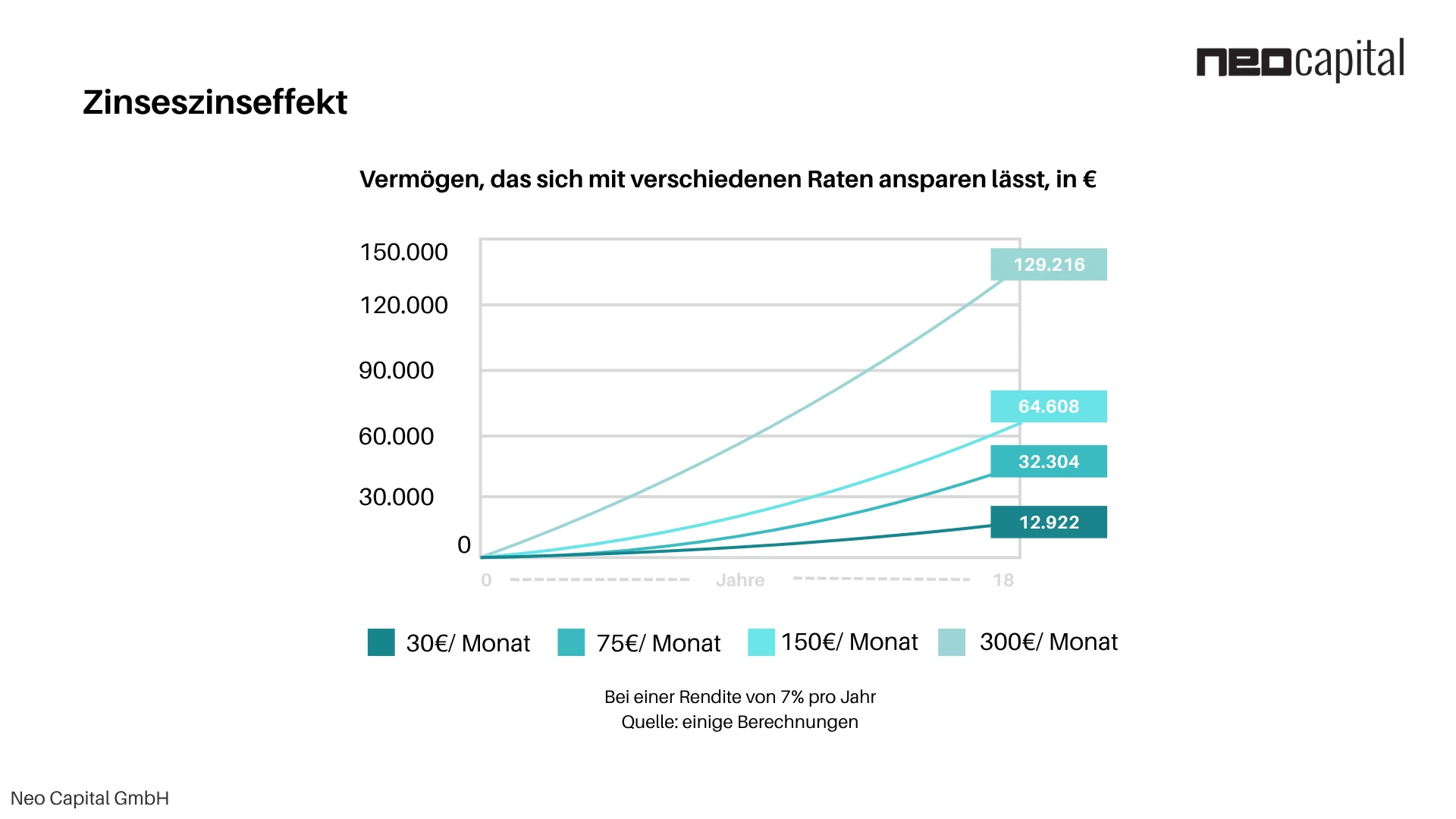
A key success factor in building wealth for children is time. The earlier capital is invested, the stronger the compound interest effect. Even regular savings instalments can reach a multiple of their original value over a period of 15 to 20 years. It becomes clear that what matters is not the size of a one-off investment but the continuity of investing.
Even with moderate monthly contributions, significant assets are built up over the years, assuming a long-term return. For parents, this means that acting early is more important than finding the perfect time to start. Those who invest consistently make optimal use of the dynamics of the capital markets and create a solid financial foundation for the next generation.
Forms of investment for structured wealth building
Choosing the right form of investment is crucial for long-term success. While conventional savings products hardly achieve any real returns any more, broadly diversified capital market investments offer considerably better prospects. ETF-based savings plans in particular have become established in recent years as an efficient solution, as they are low-cost, transparent and perform well over the long term.
In addition, junior custody accounts (Junior-Depots) play a central role, as they allow the assets to be clearly allocated to the child and offer tax advantages. Combinations of different forms of investment can also make sense in order to spread risks while making use of growth potential. Neo Capital works with families to develop individual strategies geared towards long-term stability and plannable wealth building.
Tax aspects and structuring options
A frequently underestimated factor in building wealth for children is the tax structure. By using tax-free allowances (Freibeträge) and transferring assets early, considerable tax advantages can be realised. With long-term investments in particular, an optimised structure can help ensure that income is reinvested efficiently and wealth building is accelerated.
What matters here is the right arrangement of ownership and the form of investment. Early planning makes it possible to use the scope available under tax law while creating legal clarity. Neo Capital takes these aspects into account as part of holistic advice and ensures that wealth building and tax strategy are optimally aligned.
Wealth building as part of a long-term family strategy
Building wealth for children is more than just a financial measure. It is part of a long-term family strategy that combines security, education and financial independence, whether to finance training or studies, a property or entrepreneurial projects. Wealth built up early opens up considerably more opportunities for children later on.
At the same time, a clear structure creates transparency and predictability for the whole family. By regularly reviewing and adjusting the strategy, the assets remain flexible and can respond to changing life circumstances. Neo Capital supports families in shaping this process professionally and building stable assets over the long term.
Neo Capital adviser Markus Mages interviewed by Der Tagesspiegel
Adviser Markus Mages in an interview: under the title "Anleger in Windeln – Berlins neue Börsenbabys" ("Investors in nappies – Berlin's new stock-market babies"), Der Tagesspiegel reports on how parents are investing for their children from an early age (tagesspiegel.de).
Setting the right course early with Neo Capital
Building wealth for children is not a short-term decision but a strategic process over many years. Those who start early and invest consistently can create considerable assets even with manageable amounts.
Neo Capital supports parents and families in developing individual investment strategies, making use of tax advantages and building stable wealth structures over the long term. This creates a foundation that not only enables growth but also provides security for generations to come. If you would like to approach building wealth for your children in a structured and strategic way, now is the right time to plan the first steps.
Frequently asked questions
When should you start building wealth for children?
Over the long term, broadly diversified capital market investments such as ETFs have proven particularly efficient. They offer a good balance between risk and return and make it possible to build a diversified portfolio even with small amounts.
Which form of investment makes most sense for children?
Entrepreneurs not only bear business risks but are also more affected by fluctuations in income. Without structured planning, tax disadvantages, inefficient investments or a lack of protection often arise. Professional financial planning creates clarity here and ensures stability and long-term wealth building.
What tax advantages are there when building wealth for children?
Children have their own tax-free allowances, which can be used to structure capital income efficiently. With early planning, these advantages can be put to optimal use to accelerate wealth building.
How much should you invest each month?
The amount of the savings instalment depends on your individual financial situation. What matters is less the amount than the regularity of the investment. Even smaller amounts can lead to considerable wealth over long periods.