
5 Common Mistakes When Buying Property and How to Avoid Them in 2025
This guide refers to German law and the German tax system. It is a translation of our German original and does not replace individual tax or legal advice.
Buying property remains one of the key investment decisions in 2025, whether for owner-occupiers, for investors or as a building block of a long-term wealth strategy. But the environment has changed: higher financing costs, new statutory energy-efficiency requirements and an increasingly differentiated property market mean that small wrong decisions have a much greater impact than they did a few years ago. Anyone buying today needs not only a good property but a robust strategy. The following five mistakes are particularly widespread and can be avoided with forward-looking planning.
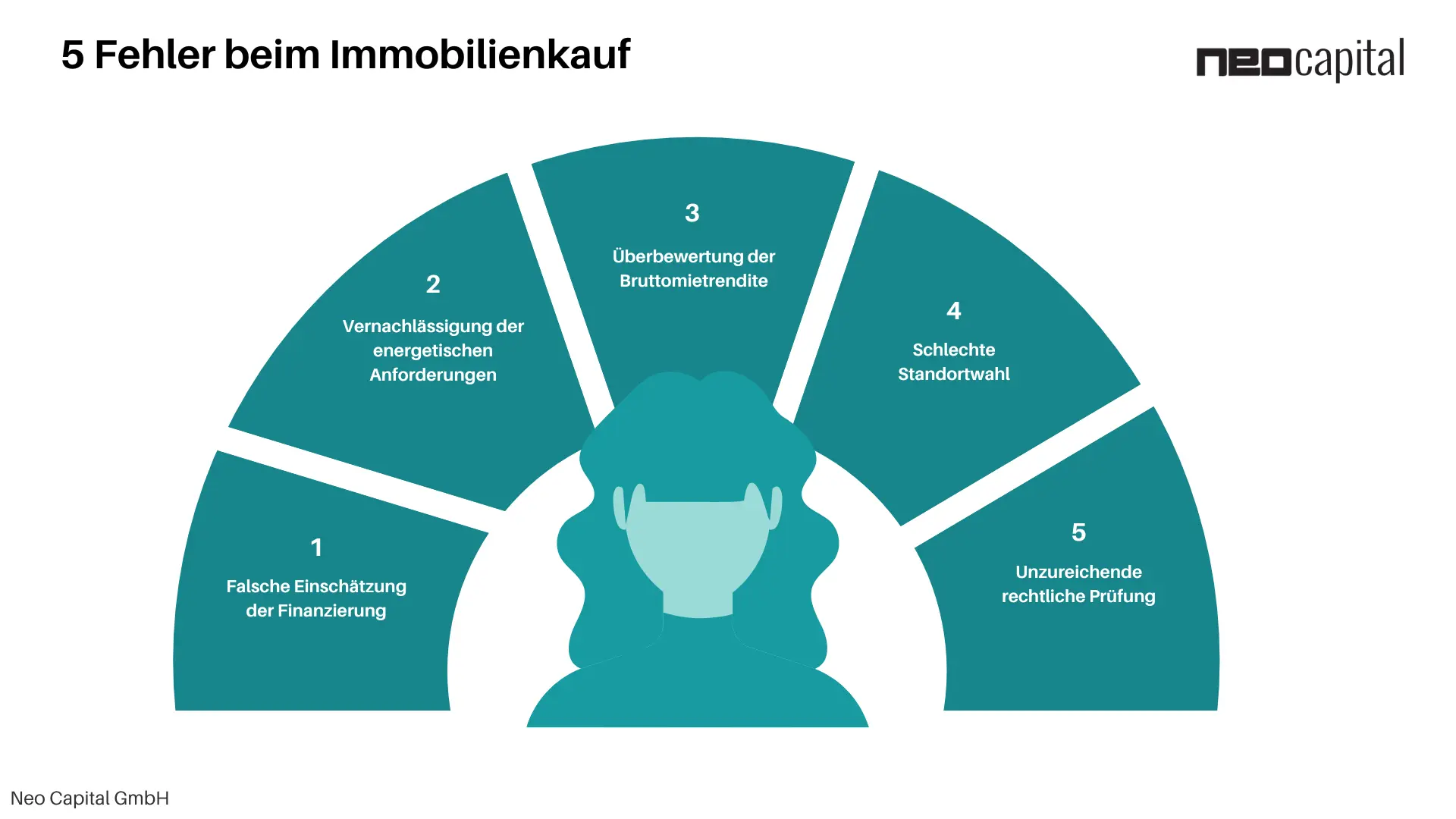
1. Financing without holistic liquidity planning
Many buyers look only at the purchase price and underestimate the actual capital required. As a rule, the ancillary costs – consisting of real estate transfer tax (Grunderwerbsteuer), notary and land registry fees, estate agent commission and initial maintenance – amount to between 8 and 15 per cent of the purchase price. Anyone who fails to factor in these items risks follow-up financing or liquidity shortfalls immediately after the purchase. Equally problematic is choosing financing solely on the basis of the lowest interest rate, without taking into account the repayment structure, the length of the fixed-interest period or flexibility options.
A sustainable financing strategy must combine predictable instalments, the tax deductibility of the interest portions and the building of adequate reserves. In 2025, many buyers face the question of whether to opt for short fixed-interest periods with lower interest rates or to choose longer periods as protection against rising rates. Combined with KfW programmes (the German state-owned development bank), repayment grants or special repayment options, long-term models can often be the more stable and economical solution – provided they are calculated early on and not improvised only after the purchase has been agreed.
2. Underestimating energy requirements and follow-up costs
Since the introduction of the Gebäudeenergiegesetz (GEG, the German Buildings Energy Act) and continuous CO₂ pricing, energy efficiency has become one of the decisive economic factors of a property. Buyers who focus solely on purchase price and location without checking the energy performance certificate or the building services may also be buying hidden renovation obligations, for example in the case of outdated heating systems or inadequate insulation. These measures can quickly cost five-figure sums and in many cases are not voluntary but required by law.
On the other hand, properties of high energy quality or eligible for subsidies offer considerable advantages: higher tax depreciation, low-interest loans and better lettability. Anyone who analyses the current energy status before buying, calculates possible renovation measures and incorporates subsidy options is investing not only in a property but in predictable operating costs and lasting value.
3. Calculating returns on the basis of gross rent only
For investors in particular, focusing on the gross rental yield often leads to wrong decisions. A supposedly attractive return of five per cent can shrink to two to three per cent – or even turn negative – after deducting management costs, reserves, vacancies and tax. Without a complete profitability calculation, a deceptive sense of security quickly arises that only becomes apparent after a few years.
A sound calculation takes into account not only rental income but also depreciation for wear and tear (AfA, Absetzung für Abnutzung), special depreciation (Sonder-AfA) under Section 7b of the German Income Tax Act (EStG), tax loss offsetting and potential sale scenarios. In practice, modern or renovated properties with a lower gross yield often perform better in the long term than supposed "bargains". Planning realistically protects you from wrong decisions as well as from unexpected tax or maintenance burdens.
4. Choosing a location based on entry price rather than future viability
A property is only as valuable as its location. Yet many buyers focus on the entry price rather than the long-term attractiveness of the location. While metropolitan regions such as Hamburg, Munich or Berlin can be expected to see stable demand and price development, numerous rural regions are struggling with demographic decline and falling purchasing power. Even within cities, there are marked differences between growth neighbourhoods and stagnating peripheral areas.
When analysing a location, you should consider not only current rents and purchase prices, but also population forecasts, infrastructure developments and the economic environment. A property that is cheap today can become expensive or worthless in ten years. Anyone who bets on the future rather than on bargains buys not just property, but permanence.
5. Lack of legal and tax review before signing the contract
Many buyers regard the purchase contract as a formality and sign without understanding the clauses. Yet property developer contracts, hereditary building right (Erbbaurecht) arrangements and let existing properties in particular involve complex provisions that directly affect costs, rights and obligations. An unspecified completion date, unclear liability for defects or an unfavourable tenancy agreement can have considerable financial consequences later on.
The question of the ownership structure is just as decisive. Whether a property is held privately or through an asset-managing company affects ongoing taxation, liability and later succession planning. This decision should not have to be adjusted after the fact: it belongs in the preparation phase of the purchase and requires a thorough tax and legal review.
Conclusion: success in buying property means strategy rather than improvisation
2025 continues to offer attractive opportunities for buyers and investors – but only for those who proceed in a structured way. Anyone who plans financing, energy efficiency, returns, location and legal structure holistically not only protects their capital but creates predictable value over decades. Neo Capital provides support precisely at this interface: from analysis and structuring through to the implementation of secure, tax-optimised property investments.
Frequently asked questions
How much equity should I plan for when buying property in 2025?
Ideally, you should have at least 8 to 20 per cent of the purchase price, including ancillary costs, available. Those who put in less must expect less favourable interest rates and higher monthly payments.
Is buying property still worthwhile despite high interest rates?
Yes – if the financing and the quality of the property are right, a purchase can make economic sense even at 4 per cent interest. What matters is not the interest rate but the overall return after taxes and value development.
When should I bring in an expert when buying property?
At the latest before signing the purchase contract, the financing, energy efficiency and legal structure should have been checked. Correcting things afterwards usually costs many times more.
How can I tell whether a location will remain stable in the long term?
Important factors are population trends, the structure of local employers, infrastructure and rent dynamics over recent years. A low entry price without prospects is not an advantage but a risk.