
Property Price Trends 2025: Focus on Residential Real Estate
This guide refers to German law and the German tax system. It is a translation of our German original and does not replace individual tax or legal advice.
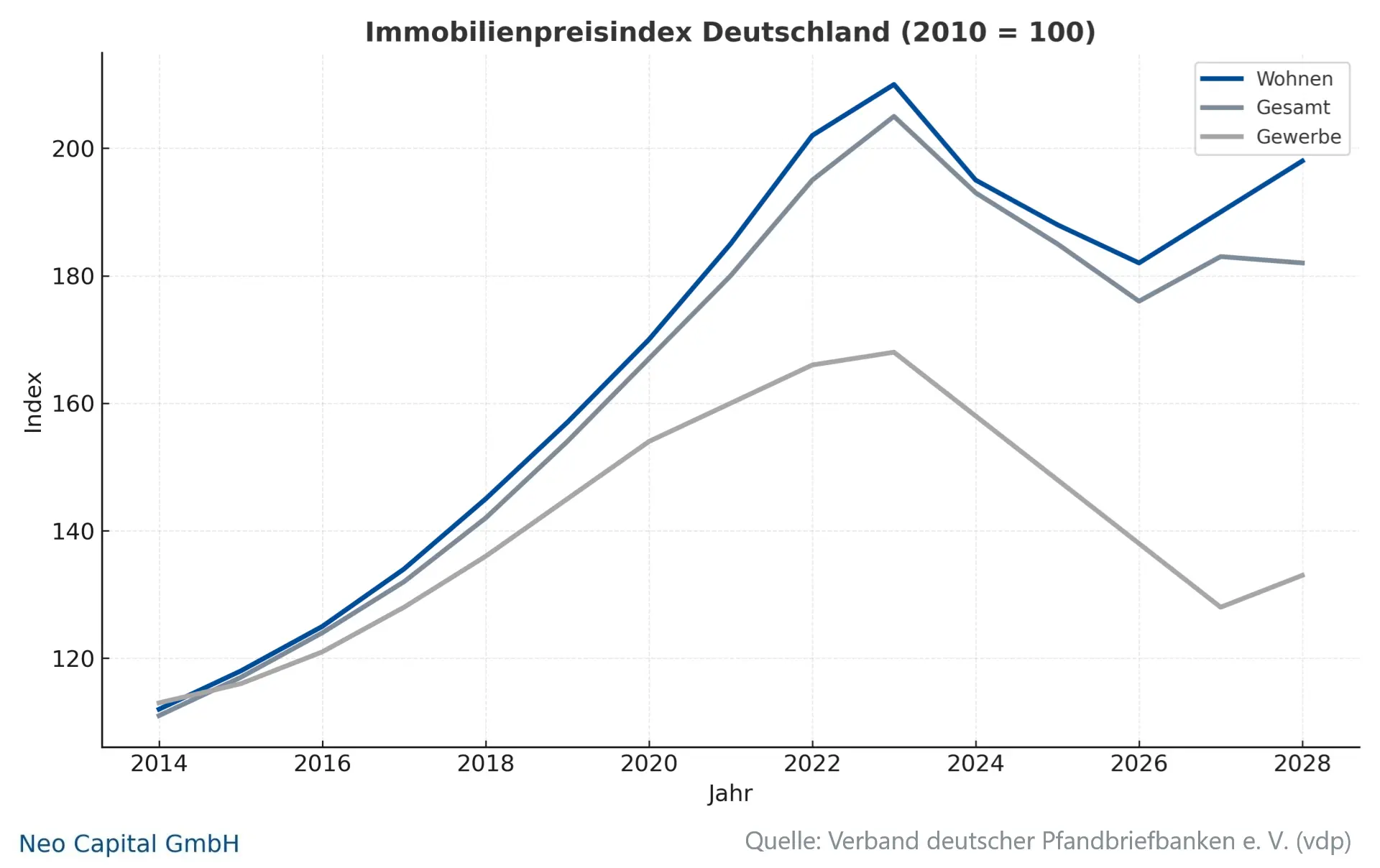
The development of property prices in 2025 is being followed with great interest by investors, buyers and sellers alike. After a phase of strong price increases between 2010 and 2021, followed by a marked cooling in 2022 and 2023 due to rising interest rates, the market is now in a consolidation phase. Those who understand the current market parameters and use them in a targeted way can realise attractive opportunities and position their investment successfully for the long term.
Current data show that the market has stabilised since the end of 2024 and in 2025 is even rising moderately again in many places. Particularly in major cities such as Berlin, Hamburg or Munich, where the supply of building land and existing flats is scarce, there is still excess demand – here, price development is more robust than in rural areas or in B and C cities.
Macroeconomic conditions
A key driver of price development is the interest rate policy of the European Central Bank: after several rate rises to combat inflation, interest rates are now higher but have stabilised. As a result, financing has become more demanding but more predictable – buyers examine more carefully whether an investment will pay off in the long term. Even though core inflation in Europe has recently eased, construction and energy costs remain high: new builds are becoming more expensive, while well-maintained or energy-efficiently renovated existing flats are gaining in value. Especially in cities with strict climate targets and a tight housing market, energy-efficient properties benefit disproportionately.
Regional differences and demand factors
Market development in 2025 is highly differentiated. In the top 7 cities (Berlin, Hamburg, Munich, Cologne, Frankfurt, Stuttgart, Düsseldorf), demand remains stable, and asking prices for owner-occupied flats have been rising for several consecutive quarters after previously bottoming out – prices are just below or in some cases already above the record level of 2022. Commuter belt regions benefit from buyers moving to the surrounding areas to obtain lower prices and more space, especially where there are good public transport links. In B and C locations, on the other hand, caution is advised: despite gross rental yields in some cases above 5%, prices there are still 15–20% below the 2022 peak, as population decline in structurally weak regions and the CO₂ pricing of energy-inefficient properties weigh on demand and value prospects. Despite higher financing costs, overall demand remains high but more selective – driven by a limited supply of new builds in metropolitan areas, ongoing urbanisation (population growth of around 15% is forecast for Berlin by 2050) and the growing importance of energy efficiency when buying.
Tax levers for residential property investors
For private and institutional investors in Germany, interesting tax opportunities continue to open up in 2025, complemented by low-interest KfW loans (from the German state development bank) and repayment grants for energy-efficient renovations and new builds to Efficiency House (Effizienzhaus) standard:
- Declining-balance depreciation (degressive AfA, Section 7(5) of the German Income Tax Act, EStG): new builds can be depreciated at up to 5% per year
- Special depreciation (Sonder-AfA) under Section 7b EStG: additional depreciation options for certain eligible new builds
- Section 6b EStG – tax-neutral reinvestment: gains from older properties can flow tax-free into new builds
Example calculation: tax levers for a new-build property
In 2025, an investor acquires a new-build flat in Berlin-Grünau for €450,000 with a building share of €350,000. Declining-balance depreciation (5% p.a.) allows €17,500 to be deducted for tax purposes, and special depreciation under Section 7b EStG (5% in the first year) a further €17,500 – meaning that €35,000 can already be claimed for tax purposes in the first year. At an income tax rate of 42%, this corresponds to a tax saving of €14,700 in the first year alone, which noticeably increases the achievable return on equity.
CO₂ tax: when properties become a risk
The CO₂ tax was introduced to reduce emissions in the building sector and to promote energy-efficient renovations – for landlords of energy-inefficient properties, however, it means a growing cost burden. Since 2023, a tiered model for splitting CO₂ costs has applied in Germany: for efficient buildings, the tenant bears most of the tax; for energy-inefficient properties, the landlord bears the majority. With rising prices per tonne of CO₂ (from around €45/t currently to €65/t and more in future), this burden is growing noticeably, reducing the net rental yield and increasing the risk of losses in value. In the long term, energy-efficiently renovated or newly built properties will therefore not only be more attractive when sold, but also enable more stable returns.
Conclusion: Neo Capital as your partner for real estate investments
The development of property prices in 2025 requires investors, more than ever, to carry out sound analysis, strategic planning and to bring tax expertise. Neo Capital supports wealthy private individuals, entrepreneurs and institutional investors in identifying, reviewing and implementing real estate investments that offer both substance and tax efficiency – via a network of tax advisers, notaries, lawyers and family offices that also provides access to off-market properties and integrates them optimally into existing wealth structures.
Frequently asked questions
How are property prices developing in Germany in 2025?
Property prices are developing very differently from region to region in 2025. While major cities such as Berlin, Munich or Hamburg continue to record stable to slightly rising prices, rural regions and B locations are coming under greater pressure – especially in the case of existing properties that have not been energy-efficiently renovated.
Is it still worth buying a property in 2025?
Yes – buying a property can still be worthwhile in 2025 if the location and energy quality are right. Buyers also benefit from tax advantages such as declining-balance depreciation (Section 7(5) EStG) and KfW funding for energy-efficient new builds and renovations.
What are the risks of buying a property in 2025?
The biggest risks lie in rising financing costs, energy-inefficient buildings and regions with population decline. There is a threat of falling values and higher ancillary costs due to CO₂ pricing.
How do interest rates affect property prices in 2025?
In 2025, interest rates remain above the historic low of the last decade, which has made financing more demanding. At the same time, interest rates are stabilising slightly, which once again offers greater planning certainty. In a long-term comparison – mortgage interest rates in Germany have averaged 6–6.5% p.a. (arithmetic mean) – the current level is still below average.
What does the CO₂ tax mean for buyers and landlords?
The CO₂ tax mainly affects buildings that have not been energy-efficiently renovated. For poor energy classes, landlords have to bear a large part of the costs, which reduces the net rental yield and will increase further as the CO₂ price rises (in future above €100/t). For buyers, energy efficiency is therefore becoming the key value factor of a property.
Should I invest in a new build or an existing property?
New builds offer high energy efficiency, tax depreciation options and greater planning certainty. Existing properties can be attractive if a considerable price discount is achieved and renovation potential can realistically be implemented – supposedly high gross rental yields above 5% often fail to live up to their promise on closer inspection, including renovation costs and the CO₂ tax.
Which locations are particularly attractive in 2025?
The large metropolitan regions with a strong economy, population inflow and stable infrastructure remain particularly interesting – such as Berlin, Munich, Hamburg or Frankfurt. Well-connected commuter belt locations can also offer opportunities, while structurally weak regions with population decline should rather be avoided.