
CO2 Levy and the Landlord's Share in 2025: Understanding Costs, Protecting Returns, Using Strategies
This guide refers to German law and the German tax system. It is a translation of our German original and does not replace individual tax or legal advice.
Rising CO2 prices present private and institutional landlords with new challenges in 2025. Since the introduction of the tiered model (Stufenmodell), CO2 costs in Germany are no longer passed on to the tenant in full but are shared proportionally between landlord and tenant, depending on the energy performance of the building. For landlords, this means that the poorer the efficiency standard, the higher their own share of the costs. While highly efficient buildings are almost entirely relieved, landlords in the lower efficiency classes bear most of the CO2 levy themselves.
This creates a twofold potential for landlords. On the one hand, energy-efficiency measures make properties future-proof; on the other, renovation costs can be cushioned considerably through tax instruments and subsidies. What is crucial, however, is a forward-looking strategy that gives equal weight to technical feasibility, economic sense and tax optimisation. Renovating "on demand", by contrast, carries the risk of missing opportunities or using funds inefficiently.
The 2025 tiered model: how CO2 costs are now allocated
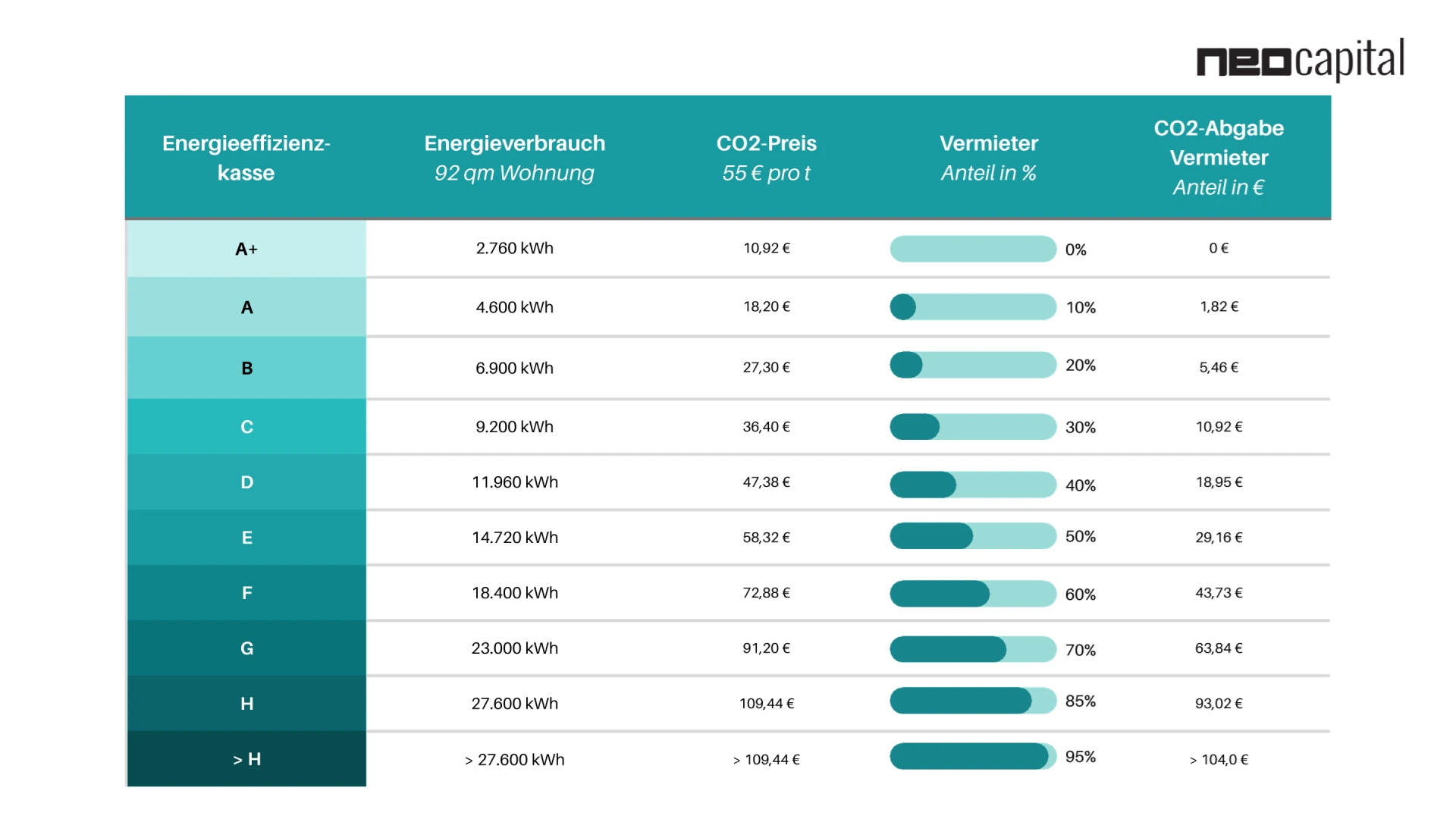
The CO2 Cost Allocation Act (CO2-Kostenaufteilungsgesetz) assigns buildings to efficiency classes from A+ to H. The higher the consumption, the larger the landlord's share. In highly efficient buildings (class A+ or A), tenants bear almost the entire CO2 levy themselves. If consumption rises into classes E, F, G or H, however, the landlord's share increases considerably. In poor efficiency classes, the landlord can bear up to 95% of the CO2 costs. This results in a noticeable loss of return, particularly for larger residential portfolios.
A practical example illustrates the impact: depending on the efficiency standard, an average 92 m² flat generates CO2 costs of between around €11 (A+) and over €109 (H). The landlord's share ranges from €0 to over €100 per year. Even if the absolute figures appear moderate, the costs add up across an entire portfolio and act like an additional deduction from the annual rent. For all poorly insulated or outdated properties, this means a noticeable deterioration in the net return.
Effects on returns, cash flow and value development
The CO2 levy has a direct effect on ongoing cash flow. Properties with high energy consumption lose appeal because they not only cause higher service charges for tenants but also place a financial burden on the landlord. The higher the landlord's share, the more the annual return falls, with no possibility of passing these costs on as operating costs. In the long term, this causes energy-inefficient buildings to fall behind modern properties in the market.
The value of the property itself is also affected: buyers are paying increasing attention to energy performance indicators, as poor values increase future cost risks. Banks are increasingly taking efficiency standards into account in their risk models, which makes it harder to finance buildings with poor energy performance. For landlords, this means that anyone who ignores energy issues accepts not only ongoing costs but also losses in value and limited marketing opportunities.
Securing the ability to pass on costs: energy-efficiency measures and modernisation surcharges
The CO2 levy does not necessarily have to remain a permanent burden. Landlords can actively reduce their share of the costs by improving the energy efficiency of their building. Measures such as insulation, new windows, modern heating systems or hybrid and heat-pump technology can lift the building into a better efficiency class, which drastically reduces the landlord's share or eliminates it entirely. At the same time, tenants' heating costs fall, which improves living quality and makes future rent increases easier.
In addition, modernisation measures can be partly passed on through the rent by means of the modernisation surcharge (Modernisierungszuschlag). The legislator recognises energy-efficient renovations as value-enhancing measures. Under Section 559 of the German Civil Code (BGB), landlords can add up to 8% of the modernisation costs per year to the rent – a decisive lever for cushioning the economic burden and securing the financing of the measures. Used correctly, the CO2 burden can thus be turned into a return advantage.
Strategies for 2025: reducing costs rather than accepting them
A successful landlord strategy begins with an analysis of the building standard. What matters is not only the energy performance indicator but the question of which measures have the greatest impact on the efficiency class. Targeted partial measures are often sufficient, such as replacing the heating technology or installing new windows, to reduce the landlord's share significantly. These measures can often be deducted for tax purposes, increase the value of the building and lower operating costs in the long term.
Landlords should also actively review their service charge structure and, where appropriate, strengthen the items that can be passed on through measurable efficiency gains. Documenting the measures is also important, so that the building's classification can later be explained clearly to tenants or authorities. Those who act proactively not only protect their cash flow but also increase the quality and competitiveness of their entire property portfolio.
Conclusion: CO2 costs can be managed and are a strategic advantage for forward-thinking landlords
The 2025 CO2 levy tightens the economic requirements for landlords but at the same time opens up new scope for action. The key insight is that CO2 costs are not a fixed loss but factors that can be managed and planned. Those who improve the building's efficiency class not only achieve a significant reduction in the landlord's share but also increase rental appeal and property value.
With a clear renovation strategy, technical expertise and a legally sound approach to passing on costs, the burdens can not only be offset but in many cases even turned into a long-term return advantage. Neo Capital supports landlords in making targeted use of these levers, exploiting tax potential and structuring property portfolios to be future-proof.
Frequently asked questions
How is the CO2 levy split between landlords and tenants from 2025?
Through a tiered model based on the energy efficiency class. The poorer the class, the higher the landlord's share, up to 95%.
Can landlords pass CO2 costs on to tenants?
Only in very energy-efficient buildings. In poorer classes, the landlord's share is mandatory and cannot be passed on.
Which measures reduce the landlord's share?
Insulation, new heating technology, an improved building envelope, window replacement or switching to efficient heat generators. Every measure that improves the efficiency class reduces the CO2 burden.
Can energy-efficient renovations be passed on through the rent?
Yes. Under Section 559 BGB, up to 8% of the modernisation costs can be added to the rent each year.
Why should landlords act now?
Because CO2 costs add up, weigh on the annual return and have a negative impact on property value. Early measures secure cash flow, value stability and tenant satisfaction.