
Avoiding Real Estate Transfer Tax on Succession: Transferring Assets Tax-Neutrally, Avoiding Risks
This guide refers to German law and the German tax system. It is a translation of our German original and does not replace individual tax or legal advice.
The tax-neutral transfer of property within the family is one of the most sensitive areas of wealth planning. While German law provides generous exemptions for genuine cases of inheritance and conventional gifts, other provisions – in particular Section 1(2a) of the German Real Estate Transfer Tax Act (GrEStG, Grunderwerbsteuergesetz) – apply strictly as soon as arrangements are implemented incorrectly in formal terms or in terms of timing. For families with property assets, it is therefore crucial to plan early and to structure the transfer routes so that real estate transfer tax (Grunderwerbsteuer) is avoided entirely.
Gifts, acquisitions "upon death" (von Todes wegen) and the correct structuring of company shares can remain entirely exempt from real estate transfer tax, provided the transfer is genuinely subject to the inheritance and gift tax regime and does not exceed the tax limits for acquisitions beyond one's share. If, on the other hand, assets are transferred without a clear structure, high tax burdens may arise that could have been avoided with forward-looking planning.
Inheritance and anticipated succession: when property passes tax-neutrally
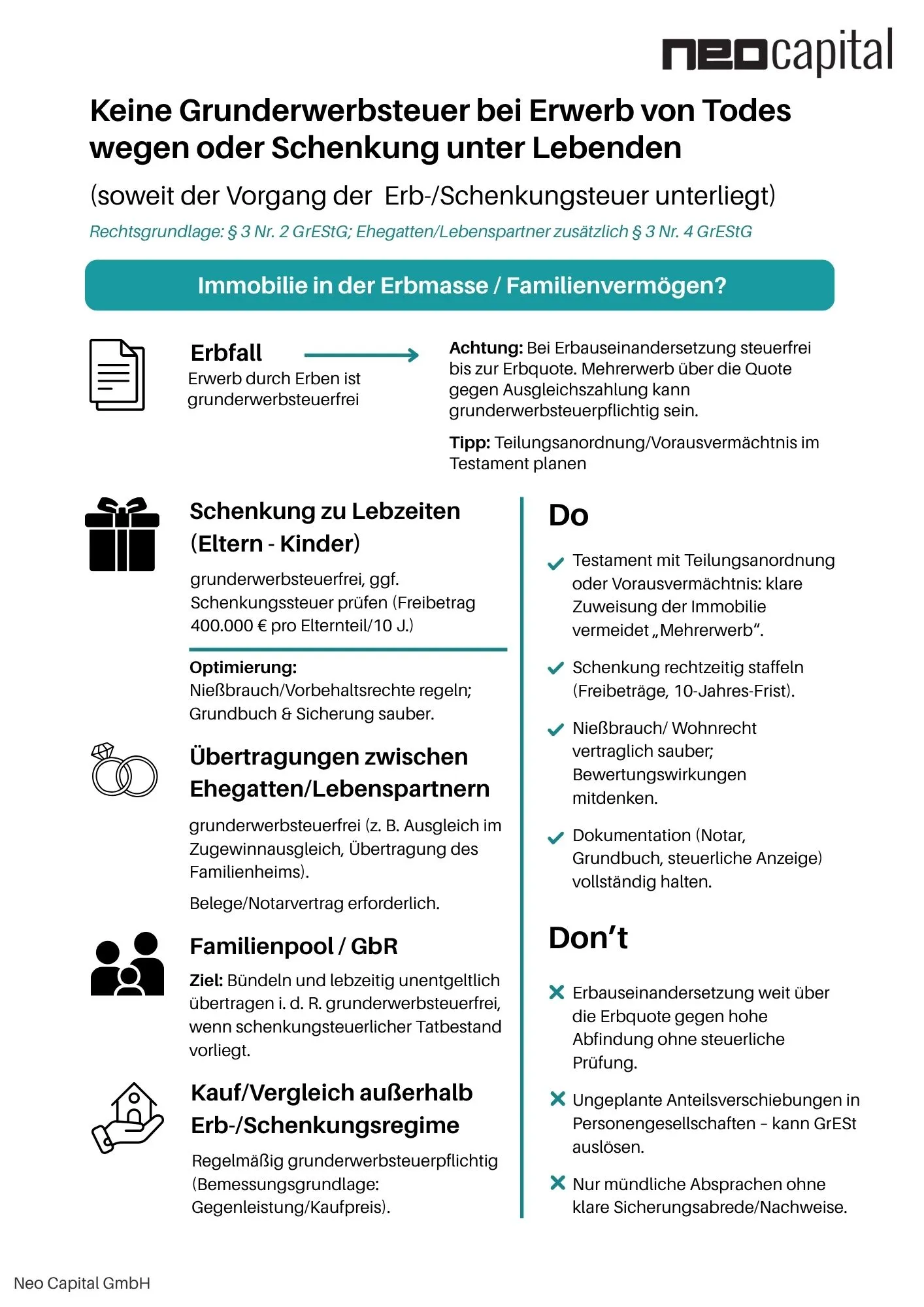
A conventional inheritance is one of the safest ways to avoid real estate transfer tax entirely. All transfers of property ownership "upon death" are exempt from real estate transfer tax, regardless of how high the property value is or how large the community of heirs (Erbengemeinschaft) is. Things become more complex, however, when the estate is later divided among the heirs (Erbauseinandersetzung): parts of a property can only be taken over tax-free up to the amount of the respective inheritance share. As soon as an heir acquires shares beyond their quota and pays out siblings, real estate transfer tax may arise. This can only be prevented through clear testamentary provisions.
As part of anticipated succession (vorweggenommene Erbfolge), i.e. through lifetime gifts, property can also be transferred free of real estate transfer tax. Parents can transfer property to their children in full and free of charge, provided the transaction is subject to gift tax (Schenkungsteuer). Here the law provides extensive tax-free allowances that become available again every ten years. By reserving usufruct (Nießbrauch) or a right of residence (Wohnrecht), the taxable value can also be reduced considerably without the parents losing their financial security. The prerequisite, however, is that the gift is planned in good time and implemented cleanly under civil law.
Transfers between spouses: scope for structuring without a tax burden
Within marriage there are particularly generous options for moving property tax-neutrally. Transfers between spouses or registered civil partners are exempt from real estate transfer tax, regardless of whether they concern the family home, a let property or other assets. This also applies to transfers in the context of the equalisation of accrued gains (Zugewinnausgleich), for example when changing the matrimonial property regime or adjusting the asset structure. For many families, this is a key lever for allocating property correctly at an early stage and making optimal use of tax-free allowances later on.
Such transfers are particularly useful when property values have risen sharply or when later gifts to children are to be prepared strategically. Tax-free reallocation within the marriage allows assets to be relieved, distributed and legally organised. It is important that every transfer is notarised and that ownership is correctly recorded in the land register (Grundbuch). Only a properly structured transfer can prevent later disputes or tax problems.
Family pools and partnerships: opportunities and pitfalls
Many families today decide to pool their property assets in a partnership, often a GbR (German civil-law partnership). A family pool makes administration, succession planning and structuring easier but can involve tax risks. Gratuitous transfers of partnership shares are generally exempt from real estate transfer tax as long as they qualify as gifts. This enables a gradual, cross-generational transfer without an immediate tax burden. At the same time, rights such as usufruct or voting rights can be structured flexibly.
It becomes critical, however, when partnership shares are shifted. If a large proportion of the shares is redistributed within a period of ten years, this can be treated for tax purposes as a transaction subject to real estate transfer tax, even if no property was transferred directly. Such share movements are then regarded as indirect transfers of real property. Precise timing is therefore crucial for family pools. Any change in the shareholding structure should be reviewed for tax purposes before it is implemented.
Avoiding wrong decisions: why clear structuring is indispensable
Many taxable transactions arise not from deliberate arrangements but from a lack of coordination within the family. Equalisation payments when dividing an estate, informal agreements on moving assets or ill-considered transfers of shares in companies can unintentionally trigger real estate transfer tax. Such mistakes can only be avoided if asset transfers are planned with foresight and accompanied by legal and tax advice.
Clean documentation, clear contractual provisions and a well-thought-out will form the basis for a tax-neutral transfer. At the same time, usufruct rights, rights of residence or reversion clauses should be precisely worded in order to make use of valuation advantages and ensure financial security. Families who plan early retain control over their asset structure and avoid tax burdens that can no longer be corrected later.
Conclusion: transferring tax-neutrally through planning, structure and foresight
Real estate transfer tax can be legally avoided in cases of succession, gifts and intra-family transfers, provided the transactions are structured deliberately, correctly and strategically. For families with property assets, German law offers numerous ways to pass on assets tax-free while making optimal use of gift and inheritance tax rules. The key is to avoid typical mistakes such as uncontrolled payouts, unclear changes in shareholdings or a lack of contractual safeguards.
Professional support ensures that arrangements are implemented in a legally sound, economically sensible and tax-optimised way. Neo Capital helps families to secure their assets over the long term, structure transfers transparently and avoid real estate transfer tax entirely within the scope of the statutory exemptions. The result is wealth planning that connects generations: tax-optimised, legally sound and designed with foresight.
Frequently asked questions
When is no real estate transfer tax payable on inheritances?
On every acquisition "upon death". Caution is required, however, when the estate is divided among the heirs: acquisitions beyond one's share in return for equalisation payments may be taxable.
Are gifts between parents and children automatically tax-free?
Yes, as far as real estate transfer tax is concerned. What matters is that the gift is made entirely free of charge and is properly documented. Tax-free allowances also enable tax-optimised transfers.
What role does a partnership play in property transfers?
A family pool can make transfers easier but carries risks when shares are shifted. If large shares are moved within ten years, real estate transfer tax may arise.
What should be considered for transfers between spouses?
They are generally tax-free. Ideal for reallocating assets and preparing for later succession, provided the notarial contract and the land register are unambiguous.
How can mistakes be reliably avoided?
Through clear testamentary provisions, early tax planning, complete documentation and the support of experienced advisers who structure the arrangements in a legally sound and tax-neutral way.