
Behavioural Finance Explained: Why Investors Often Act Against Their Own Interests
This guide refers to German law and the German tax system. It is a translation of our German original and does not replace individual tax or legal advice.
Behavioural finance addresses the question of why investors frequently make suboptimal decisions despite the information available and rational strategies. While classic financial theories assume that market participants act rationally, practice paints a different picture. Emotions, cognitive biases and behavioural patterns have a considerable influence on investment decisions and therefore on long-term returns.
This topic is of central importance for entrepreneurs and wealthy private investors in particular. After all, it is not the selection of individual investments that determines long-term success, but how you behave in the face of market phases, uncertainty and volatility. Neo Capital helps investors to understand these psychological factors and translate them into a structured, disciplined investment strategy.
The behavioural gap: the difference between market return and investor outcome
A central concept within behavioural finance is the so-called behavioural gap. It describes the difference between the actual market return and the return that investors really achieve. Studies show that many investors fall well short of what the capital markets offer. The cause is rarely the strategy itself, but rather behaviour during the investment phase.
Typical patterns are buying and selling at the wrong time, often triggered by short-term market movements. Investors invest more heavily after prices have risen and withdraw capital after declines. This behaviour means that potential returns are systematically given away. A clear, long-term strategy helps to reduce this effect and bring your own result closer to actual market performance.
Typical behavioural patterns and their impact on returns
One of the most common cognitive biases is loss aversion. Losses are perceived far more strongly on an emotional level than gains, which leads investors to react hastily in weak market phases. At the same time, overconfidence plays a role, i.e. overestimating one's own abilities when selecting investments or timing markets.
Another widespread pattern is so-called herding. Investors take their cue from the behaviour of other market participants instead of making their own well-founded decisions. Combined with media coverage, these effects are amplified further. The result is pro-cyclical decisions that lead to lower returns over the long term. These behavioural patterns are not the exception but a structural part of human decision-making. Successful investment strategies therefore take into account not only markets but also the behaviour of the investor.
Discipline as the decisive success factor in investing
Long-term investment success is based less on short-term decisions than on consistent implementation. Disciplined investors follow a clearly defined strategy, regardless of short-term market fluctuations. This is precisely where one of the greatest added values of professional advice lies.
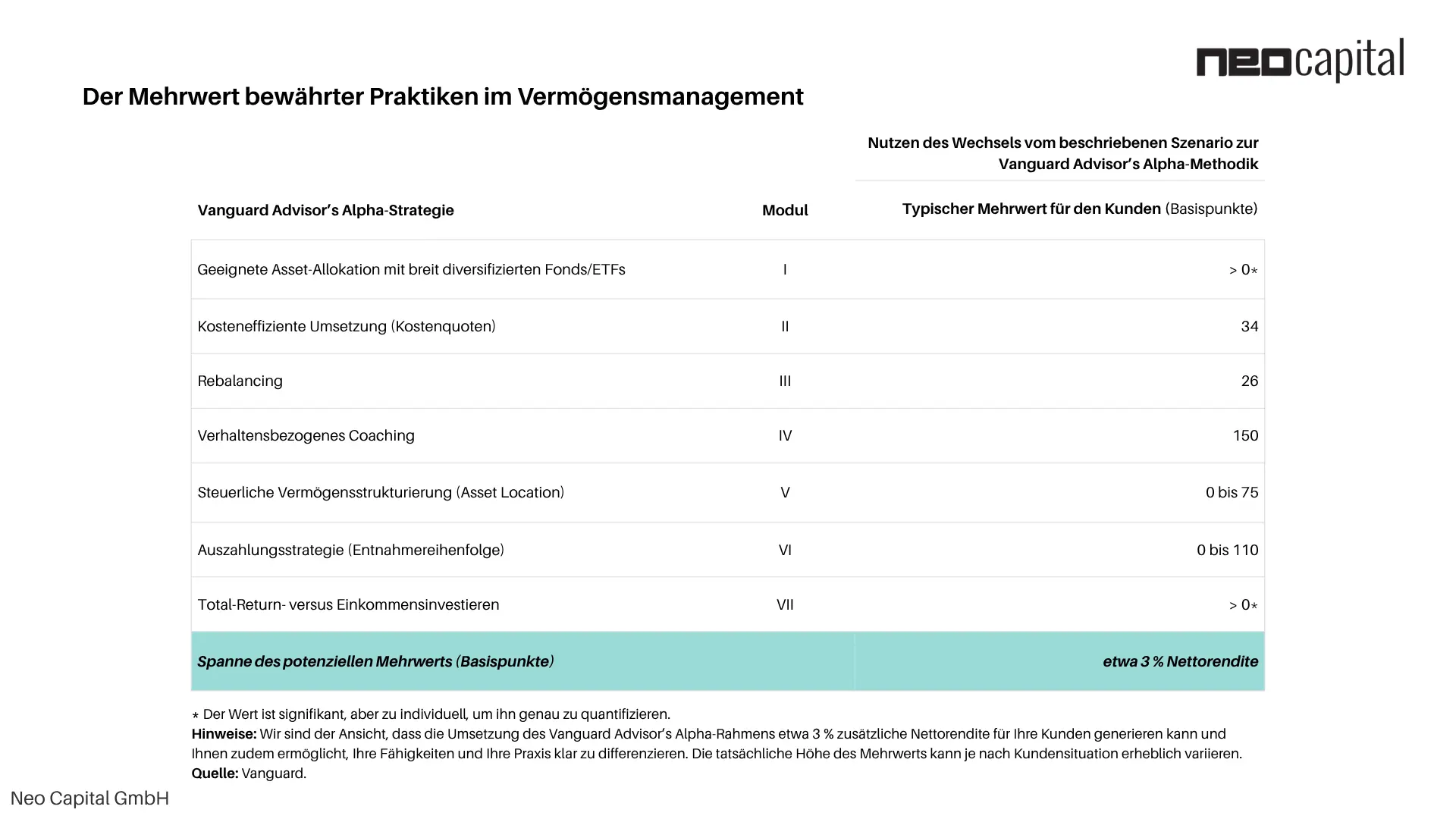
Approaches such as the "Advisor's Alpha" described in the Vanguard context show that structured behaviour, rebalancing and consistent implementation of a strategy can have a significant influence on net returns. Behavioural coaching in particular is highlighted as one of the most important factors, as it helps investors to avoid emotional misjudgements. This is exactly where Neo Capital comes in. Clear processes, structured portfolios and ongoing support ensure that investors act rationally and in line with their strategy even in volatile market phases.
Behavioural finance as part of a holistic wealth strategy
Behavioural finance is not an isolated topic but an integral part of modern wealth strategies. Alongside asset allocation, tax optimisation and risk management, the investor's behaviour plays a decisive role in long-term success.
A well-thought-out strategy therefore combines several levels. It takes into account global diversification, scientifically sound investment approaches and, at the same time, the psychological challenges facing the investor. The aim is to create a system that not only works in theory but is also sustained in practice. Combined with tax considerations in particular, this creates additional leverage. Anyone who structures capital efficiently, optimises income and invests with discipline at the same time can build significantly more stable wealth over the long term.
Reducing the behavioural gap in a targeted way with Neo Capital
Behavioural finance impressively shows that the greatest risk factor in investing is often not the market but your own behaviour. Anyone who understands this connection and actively manages it can gain a decisive advantage. Neo Capital supports entrepreneurs and wealthy private investors in implementing well-founded investment strategies, avoiding emotional misjudgements and structuring capital efficiently. The aim is to convert tax burdens into private wealth in a targeted way and to invest it for the long term, with discipline and a focus on returns.
Frequently asked questions
What is behavioural finance?
Behavioural finance examines how psychological factors and behavioural patterns influence financial decisions. It focuses on emotional reactions and cognitive biases that can lead to irrational investor behaviour.
What is the behavioural gap?
The behavioural gap describes the difference between the return of an investment and the return an investor actually achieves. It is usually caused by poor decisions about when to buy and sell, or by a lack of discipline.
Why do investors often act irrationally?
Emotions such as fear and greed, as well as thinking errors such as overconfidence or herding, mean that decisions are not made on a purely rational basis. These patterns are deeply rooted in human behaviour.
How can typical mistakes be avoided?
A clear investment strategy, a long-term focus and professional guidance help to reduce emotional misjudgements. Discipline and structure are crucial for investment success.