
Building a property portfolio strategically: steps, financing, taxes and risks
This guide refers to German law and the German tax system. It is a translation of our German original and does not replace individual tax or legal advice.
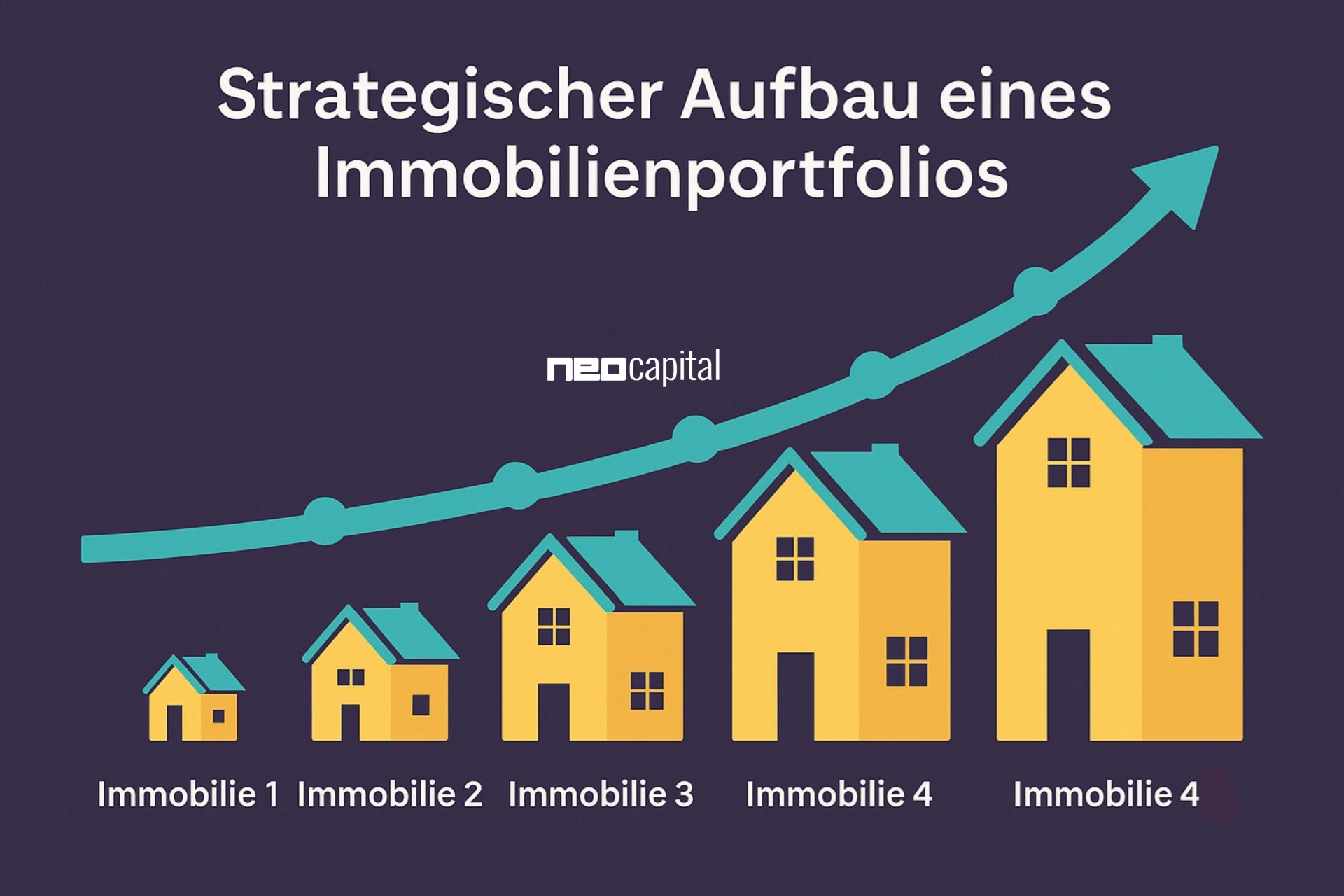
Many portfolios come about by chance: one flat follows another because an offer happens to fit. The result is often similar properties in one location, loans with the same expiry date and tax consequences that nobody planned. A strategically built property portfolio, by contrast, starts with the question of what the properties should do for you in ten or twenty years. This guide covers the steps, the financing logic, the tax rules with sources and the risks you should limit from the outset.
Building a property portfolio: the 6 steps
- Set the goal and time horizon: Should the portfolio generate ongoing surpluses, build wealth over the long term, reduce taxes in high-income years or later replace a pension? The goal determines property type, location and financing.
- Clarify the financing framework: Equity, income, existing loans and a liquidity reserve determine how much volume you can carry – even if interest rates rise or a flat stands empty.
- Select properties according to plan: Every new property must fill a gap the portfolio still has and must pay off even without a tax effect.
- Spread the risks: Mix locations, property types, construction years and tenant structure so that a single event does not hit the whole portfolio.
- Factor in taxes from the start: Depreciation, holding period, sale planning and the right structure (private or company) all shape the after-tax result.
- Review regularly: Check fixed-rate periods, rents, maintenance and value development every year and adjust the portfolio in a targeted way.
Strategy before property: cash flow, capital growth or tax effect?
The most important decision is made before the first purchase: what role should property play in your overall wealth? The following strategy types are not mutually exclusive, but they set different priorities. Many portfolios combine them over time.
| Strategy | Goal | Typical properties | What matters |
|---|---|---|---|
| Cash-flow oriented | ongoing surplus after interest, repayment and costs | existing flats with solid rents, often outside the most expensive locations | higher equity, maintenance, tenant creditworthiness |
| Growth oriented | long-term wealth building through location and substance | flats in sought-after, scarce locations | staying power; an ongoing shortfall must be affordable |
| Tax oriented (new build) | tax savings in high-income years | new rental flats with declining-balance depreciation, possibly EH40 with QNG seal | deadlines and requirements, viability without the tax effect |
| Retirement provision | debt-free rental income in retirement | mix of existing stock and new build, debt paid off by retirement | repayment plan, maintenance in old age, succession |
The strategy translates into clear purchase criteria: location, maximum price-to-rent multiples, minimum condition, financing ratio. Setting these criteria in advance makes gut-feeling purchases less likely. How property can be used specifically for retirement is shown in our guide Retirement planning with real estate.
Equity, loan-to-value and financing structure
A portfolio grows through borrowed capital – and in practice that is also where it usually fails. According to the Bundesbank interest rate statistics, the effective interest rate for housing loans with a 5- to 10-year fixed-rate period was provisionally 3.81% in August 2026 (average across all housing loans; investors with a loan-to-value (LTV) above 95% sometimes pay up to 5% due to risk surcharges, depending on creditworthiness). Calculated gross rental yields in Berlin's existing housing stock ranged between 2.97% and 3.83% in 2025, depending on the district (derived from the asking-price medians of the CBRE/Berlin Hyp housing market report). In many locations, the ongoing rental yield is therefore in the same range as the mortgage rate: leverage no longer pays for itself.
- Use equity deliberately: You should at least cover the purchase costs yourself – in Berlin, 6% real estate transfer tax alone (State of Berlin; the rate is set by the federal states, the federal law provides for 3.5%, Section 11 GrEStG (Real Estate Transfer Tax Act)) plus notary and land register fees. The higher the loan-to-value, the higher the interest surcharge as a rule.
- Keep an eye on total exposure: Banks assess not the individual property but your entire exposure. If you bundle all properties with one bank early on and link land charges across several properties, you lose flexibility when selling or refinancing.
- Stagger fixed-rate periods: If all fixed-rate periods expire in the same year, a rise in interest rates hits the whole portfolio at once. Staggered terms spread this risk.
- Plan repayment and reserves: A liquidity reserve for vacancies, rent defaults and repairs belongs in every plan. We discuss which structure suits your situation on our mortgage financing page.
The phases of a property portfolio
| Phase | Focus | Typical questions |
|---|---|---|
| 1. Foundation | first property, financing framework, reserve | Does the property fit the strategy? Does the financing hold up even with a vacancy? |
| 2. Expansion | further properties according to purchase criteria, diversification | Which gap does the next property fill? How is total exposure developing? |
| 3. Optimisation | refinancing, maintenance, structure | Stagger fixed-rate periods? Is a company worthwhile for further purchases? Which properties to reallocate after ten years? |
| 4. Harvest and succession | debt repayment, withdrawals, transfer | Is the rental income sufficient in retirement? How can the portfolio be transferred tax-efficiently? |
Diversification: location, property type, new build and existing stock, tenants
With property, diversification does not mean owning as many properties as possible, but spreading risks deliberately. Four dimensions are decisive:
- Location: Different districts, cities or regions react differently to demand, new construction and regulation. Berlin's market is very tight – the market-active vacancy rate was 0.3% at the end of 2024, compared with 2.2% nationwide (CBRE-empirica vacancy index). How much prices and rents vary within the city is shown in our district comparison (in German); data for the surrounding region can be found in the Brandenburg research hub (in German).
- Property type: Owner-occupied flats (Eigentumswohnungen) are easy to divide and can be sold individually; apartment buildings bundle management and decisions. Commercial and special-purpose properties follow their own cycles and require specialist know-how.
- New build and existing stock: New builds offer lower maintenance requirements, higher depreciation and an exemption from the rent cap (Mietpreisbremse) on first letting (Section 556f BGB (Civil Code)). Existing stock often offers lower prices per square metre, but carries refurbishment risks. Mixing both smooths out maintenance and tax profiles.
- Tenant structure: Different flat sizes appeal to different tenant groups – singles, couples, families. A portfolio that relies on a single target group is more vulnerable to shifts in demand.
For context on prices: according to the Berlin valuation committee (Gutachterausschuss), owner-occupied flats in Berlin cost an average of €5,511/m² in 2025. We collect all figures on prices, rents and interest rates in our Berlin property market analysis 2026 (in German) and in the Berlin property market research hub.
Taxes in the portfolio: the rules you need to know
Depreciation: straight-line, declining-balance and special depreciation
Rental income is income from letting and leasing (Section 21 EStG (Income Tax Act)). From it you deduct interest, costs and depreciation (Absetzung für Abnutzung, AfA) on the building – the land share is not depreciated. Which depreciation applies depends on the property:
| Type of depreciation | Rate | Requirement | Legal basis |
|---|---|---|---|
| Straight-line, old building | 2.5% per year | completed before 1925 | Section 7(4) EStG |
| Straight-line, existing stock | 2% per year | completed 1925 to 2022 | Section 7(4) EStG |
| Straight-line, new build | 3% per year | completed from 2023 | Section 7(4) EStG |
| Declining-balance | 5% of the residual value | residential use; start of construction or purchase contract 01.10.2023 to 30.09.2029; purchase by the end of the year of completion | Section 7(5a) EStG |
| Special depreciation | 5% per year for 4 years, in addition | new rental flat, building application 2023 to 30.09.2029, Efficiency House 40 with QNG seal, construction costs max. €5,200/m², assessment basis max. €4,000/m², 10 years of letting | Section 7b EStG |
Declining-balance and special depreciation can be combined and shift a large part of the depreciation into the first years; in total, however, you can never depreciate more than the acquisition costs of the building. What this looks like in figures is shown in our worked example on declining-balance and special depreciation (in German); the requirements for the building are explained in EH40 QNG new builds in Berlin (in German). For existing properties, note: repairs exceeding 15% of the building costs within three years of purchase are not immediately deductible, but only via depreciation (Section 6(1) No. 1a EStG).
The 10-year rule: planning the holding period
If you sell a let property held as private assets within ten years of purchase, the gain is taxable as a private sale transaction (Section 23(1) No. 1 EStG). All depreciation claimed reduces the acquisition costs – so high depreciation increases a taxable gain. After ten years, the gain is tax-free. For special depreciation, the following also applies: if the flat is sold tax-free or is no longer let for residential purposes within the first ten years, the special depreciation is reversed (Section 7b(4) EStG). Plan reallocations within the portfolio around these deadlines.
The three-property limit: when asset management becomes a business
Anyone who does not just hold property but sells it regularly can become a commercial property dealer (gewerblicher Grundstückshändler). According to the Federal Ministry of Finance (BMF) circular of 26.03.2004, the indicator is this: selling more than three properties within five years of acquisition, construction or modernisation is generally commercial. Each independently usable and saleable flat counts as a separate property. The five-year period is not rigid; where there are further indications, sales up to ten years after acquisition can be counted.
- Consequence: The first three sales then also become commercial. The gains are subject to income tax regardless of the 10-year rule and are additionally subject to trade tax (Gewerbesteuer).
- No more depreciation: In commercial property dealing, the properties belong to current assets and may not be depreciated, even if they are let in the meantime.
- In practice: Anyone who lets long-term and then sells generally remains within private asset management. If you are planning several sales in quick succession, your tax adviser should check beforehand whether the limit is affected.
Hold privately or through an asset-managing GmbH?
Beyond a certain portfolio size, the question of a company arises. The main differences:
- Private assets: Rental income is subject to your personal income tax rate; losses – for example in the first years of a new build – are offset against other income. Sales after ten years are tax-free.
- Asset-managing GmbH: All income of a GmbH is treated as business income (Section 8(2) KStG (Corporation Tax Act)); the 10-year rule does not exist there, and capital gains are always taxable. If the company exclusively manages its own real estate, the extended trade tax reduction (Section 9 No. 1 sentence 2 GewStG (Trade Tax Act)) can eliminate trade tax on rental income. Profits retained in the company are taxed at a lower rate than for many private individuals; distributions are taxed again at shareholder level. Losses remain in the GmbH.
- Switching is costly: Transferring existing properties into a GmbH can trigger real estate transfer tax and – within the ten years – income tax on the gain. The structure should therefore be in place before the purchases it is intended for.
Which option pays off depends on income, withdrawal needs, holding period and succession planning, and belongs in the hands of your tax adviser. For entrepreneurs, we go into more detail in Property investments for entrepreneurs (in German).
Risks in the portfolio and how to limit them
- Interest rate risk: When refinancing, the interest rate may be significantly higher than at purchase. Countermeasures: long or staggered fixed-rate periods, sufficient repayment, calculating with higher follow-up rates.
- Concentration risk: Same location, same developer, same bank, same construction year – each of these concentrations amplifies individual risks. Countermeasure: diversification along the dimensions above.
- Vacancy and rent default: Even in tight markets, rent is sometimes lost, for example when tenants change or have payment problems. Countermeasures: liquidity reserve, careful tenant selection, market-level rents.
- Maintenance: Roof, heating, façade and energy requirements cause costs that are often underestimated – especially in existing stock. Countermeasures: reserves, reviewing the minutes of owners' meetings and the maintenance reserve before buying.
- Regulation: In areas with a rent cap (Mietpreisbremse), the rent on new lettings may generally exceed the local comparative rent by no more than 10% (Section 556d BGB); the corresponding state ordinances must expire by the end of 2029 at the latest. Berlin is one of these areas. New-build flats first used and let after 01.10.2014 are exempt – more on this in Rent cap for new builds in Berlin (in German).
- Tax risk: Laws change, deadlines are missed, the requirements for special depreciation are not met permanently. Countermeasure: purchase decisions that pay off even without a tax effect.
Checklist before your next property
- Which gap in the portfolio does the property close (location, property type, tenant group)?
- Does the property pay off even without a tax advantage and at a higher follow-up interest rate?
- How do total exposure, loan-to-value and liquidity reserve change?
- When do the fixed-rate periods of all properties expire – does the new one clash with existing ones?
- Which depreciation applies, and are the deadlines (declining-balance depreciation, Section 7b) definitely met?
- Are sales planned within the next five years (three-property limit)?
- Does the structure (private or company) fit further expansion and succession?
We support you from the first property to the portfolio structure – with market data, a financing comparison and in coordination with your tax adviser. You can find our approach under Real estate investment; for an initial conversation, please use our contact page.
Frequently asked questions
How do I start building a property portfolio?
With the goal, not the property: decide whether the portfolio should deliver ongoing cash flow, long-term capital growth, tax savings or a pension in old age. Then clarify the financing framework from equity, income and reserves and derive purchase criteria from it. Only then comes the first property.
How much equity do I need for several properties?
There is no fixed figure; it depends on creditworthiness, the bank and the property. As a minimum, you should be able to cover the purchase costs yourself – in Berlin, 6% real estate transfer tax alone plus notary and land register fees. The higher the loan-to-value, the higher the interest rate as a rule; according to the Bundesbank, the average effective rate was provisionally 3.81% in August 2026, and up to 5% in some cases with a very high loan-to-value.
What is the three-property limit?
According to the BMF circular of 26.03.2004, selling more than three properties within five years of acquisition or construction generally constitutes commercial property dealing. All gains on sale are then subject to income tax and trade tax – even after ten years – and the properties may no longer be depreciated. Each flat counts as a separate property.
When can I sell a let property tax-free?
If held as private assets, after ten years have passed between purchase and sale (Section 23 EStG). Before that, the gain is taxable, and the depreciation claimed so far increases the gain. In addition, special depreciation under Section 7b is reversed if the flat is sold tax-free within the first ten years. The 10-year rule does not apply within a GmbH.
Is an asset-managing GmbH worthwhile for my property portfolio?
That depends on the individual case. A GmbH can make sense if rental surpluses stay in the company and are reinvested; with the extended trade tax reduction, trade tax on rental income can be eliminated. Disadvantages are the absence of the 10-year rule, the taxation of distributions and the fact that losses cannot be offset against your private income. The decision should be made with your tax adviser and before further purchases.
How do I diversify a property portfolio sensibly?
Along four dimensions: location (different districts or regions), property type (flats, apartment buildings, possibly commercial), construction year (new build and existing stock) and tenant structure (different flat sizes and target groups). In addition, fixed-rate periods should be staggered, and financing should not be bundled with a single bank without good reason.