
Property as retirement provision: own home or buy-to-let?
This guide refers to German law and the German tax system. It is a translation of our German original and does not replace individual tax or legal advice.
For most people, the statutory pension alone is not enough to maintain their accustomed standard of living. Property is therefore regarded as a classic building block of private retirement provision – rightly so, because it offers something hardly any other investment does: it lowers housing costs in old age or creates an ongoing income linked to inflation.
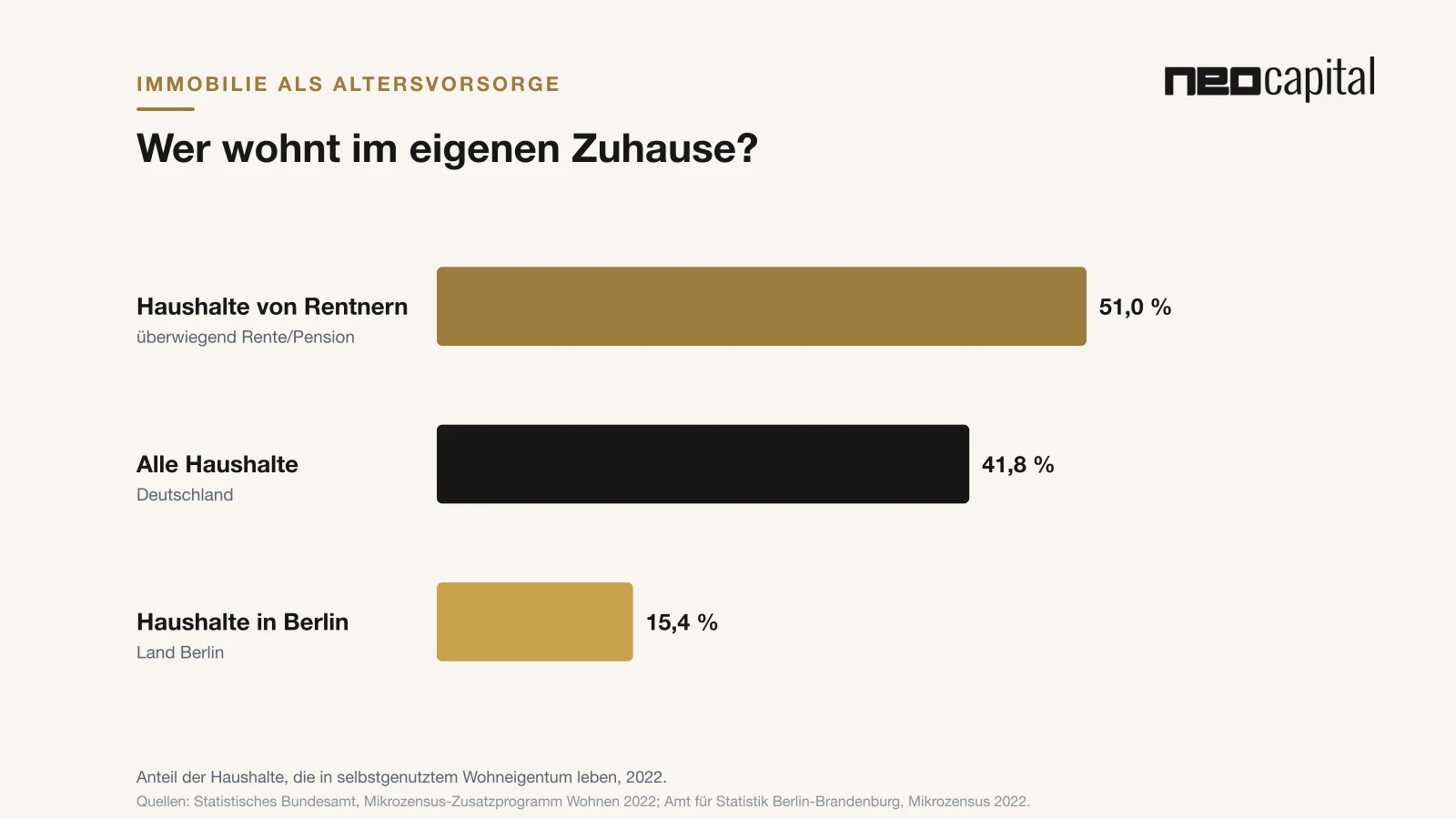
The statistics confirm its importance: according to the microcensus (Mikrozensus), 41.8% of all households in Germany lived in owner-occupied housing in 2022. Among households living mainly on a pension, the figure was 51.0% (Destatis). In Berlin the situation is quite different: only 15.4% of households live in their own home (Statistical Office for Berlin-Brandenburg) – the vast majority continue to pay rent in retirement.
Two routes: own home or rented property
| Owner-occupied home | Rented property | |
|---|---|---|
| Contribution in retirement | Rent-free living – only service charges and maintenance | Rental income as additional income |
| Tax during the saving phase | Interest and costs not deductible | Interest, depreciation and costs deductible as income-related expenses (Werbungskosten) |
| Financing | Higher equity share usual | Debt leverage, rents cover part of the instalment |
| Sale | Generally tax-free if owner-occupied | Tax-free after a ten-year holding period (Section 23 EStG) |
| Flexibility | Tied to where you live | Location can be chosen by return and demand |
| Main risks | Concentration risk, maintenance, housing needs change | Vacancy, rent default, tenancy law, maintenance |
Your own home: security through rent-free living
The greatest advantage of your own home in old age is the rent you save. Anyone who lives debt-free in their own house or flat at the start of retirement needs a significantly lower income to maintain their standard of living. Added to this is a sense of security: no rent increases, no notice to quit for the landlord's own use (Eigenbedarfskündigung).
The downside: your own home ties up a lot of capital in one place, it generates no return in the narrower sense, and you bear the costs of maintenance, modernisation and energy requirements alone. In addition, the family home often no longer fits your needs in old age – too large, not barrier-free, too far from doctors and infrastructure.
The investment property: income and tax benefits
A rented property works for you during your working life: the tenants pay part of the financing, interest, depreciation and costs reduce your tax, and in retirement, once the financing is repaid, an ongoing surplus remains. In the long term, rents tend to move with general price developments – inflation protection that nominal pensions and savings plans do not offer. How depreciation works for new builds is shown in our guide combining declining-balance depreciation and special depreciation (in German).
The success of an investment property, however, depends heavily on location, purchase price and financing. Data on rents and prices in Berlin and the surrounding area can be found in our market analyses Berlin property market and Brandenburg property market (in German).
The most important rule: debt-free by retirement
Whether own home or investment property – a property only works as retirement provision if the financing is largely repaid by the start of retirement. Otherwise, the loan instalment eats up precisely the income that is missing in retirement. So calculate backwards:
- Set the residual debt at the start of retirement: The goal is usually zero or an amount that can be repaid from reserves.
- Align repayment accordingly: Anyone who buys at 45 and wants to be debt-free at 67 has 22 years – the initial repayment rate must be correspondingly higher.
- Secure the fixed-interest period: Long fixed-interest periods or special repayment rights reduce the risk of being surprised by higher rates when refinancing.
- Plan special repayments: Bonus payments, tax refunds or severance pay can reduce the residual debt in a targeted way.
We support your planning with a comparison of over 400 banks – find out more under mortgage financing.
Wohn-Riester: subsidy for your own home
Subsidised Riester capital can be used for owner-occupied residential property (Section 92a EStG): for purchase or construction (at least €3,000), to repay a loan or – subject to minimum amounts – for age-appropriate or energy-efficiency conversion. The amounts withdrawn are recorded in a residential subsidy account (Wohnförderkonto), increased by 2% each year and taxed on a deferred basis in retirement – either spread out or all at once with a reduction. Wohn-Riester cannot be used by investors in rented property.
What owners face in old age
- Maintenance: Roof, heating, windows and façade do not last for ever. Reserves are a must – for owner-occupied flats there is also the service charge (Hausgeld) and possible special levies of the owners' association.
- Energy requirements: Replacing the heating and insulation can cause considerable costs; the CO₂ price also affects heating costs and, for rented property, the cost split.
- Accessibility: Age-appropriate conversion should be considered early on.
- Liquidity: Property wealth is not quickly available. Anyone who needs money in old age has to sell, borrow against the property or consider a property pension.
Property as one building block among several
A property is a strong building block of retirement provision – but rarely the only one. Anyone who puts their entire wealth into one property carries a high concentration risk: location, tenants, renovation needs and changes in the law then affect everything at once. A combination of property, a broadly diversified securities portfolio and – depending on the situation – tax-subsidised provision makes sense. In retirement, the portfolio can be used flexibly through a withdrawal plan (in German), while the property lowers housing costs or provides rental income.
Frequently asked questions
Is property good retirement provision?
It can be, if it is largely paid off by the start of retirement, reserves for maintenance are in place and it does not tie up your entire wealth. It then lowers housing costs or provides rental income.
Which is better for retirement: your own home or a rented flat?
Your own home saves rent in old age and provides security, but receives no tax benefits. A rented flat offers tax benefits during the saving phase and income in retirement, but brings letting risks. The answer is often a question of life planning, place of residence and wealth.
How many pensioners live in their own property?
According to the 2022 microcensus, 51.0% of households living mainly on a pension lived in owner-occupied housing. Across all households it was 41.8%, in Berlin only 15.4%.
Can I use my Riester pension for a property?
Yes, for owner-occupied residential property via Wohn-Riester (Section 92a EStG) – for example for purchase, construction or repayment. The amounts are taxed on a deferred basis in old age. This is not possible for rented property.
Is selling a property in retirement tax-free?
If owner-occupied, generally yes. Rented property held as private assets can be sold tax-free after a ten-year holding period.