
What does a financial advisor cost? Fees, commission and total costs at a glance
This guide refers to German law and the German tax system. It is a translation of our German original and does not replace individual tax or legal advice.
"The advice costs you nothing" – many investors hear this sentence. It is only true at first glance. Someone always pays the advisor, and in the end it is the clients: either directly via an invoice or indirectly via higher product costs. This overview shows which costs are typical, how to compare them and what rights you have.
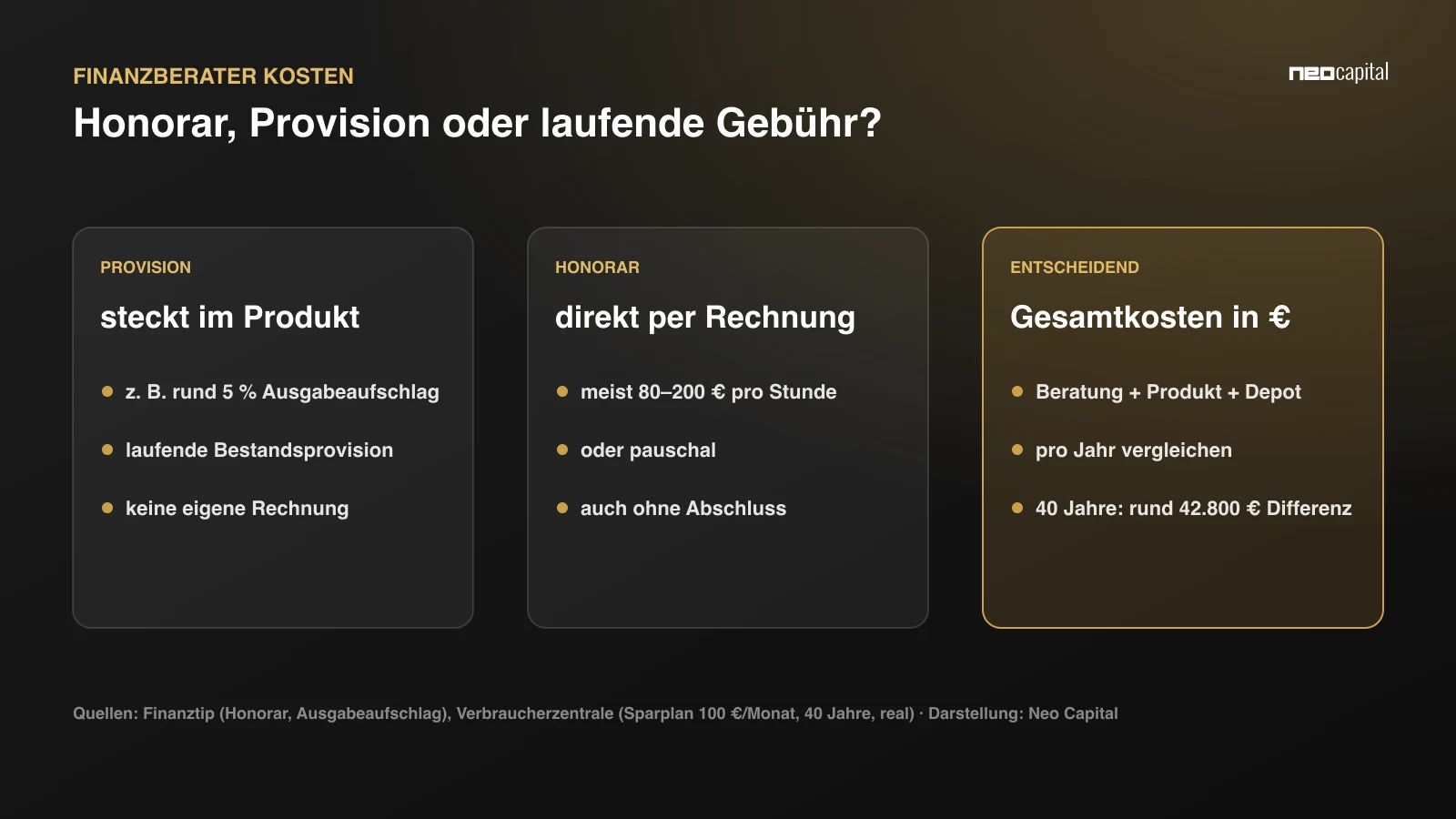
The three remuneration models at a glance
| Model | How you pay | Typical amount | What to watch out for |
|---|---|---|---|
| Commission | indirectly via the products: front-end load, acquisition costs, ongoing trail commission | e.g. a front-end load of around 5% on active funds | incentive to sell and switch; costs are built into the product |
| Fee | directly by invoice – per hour, flat rate or as a percentage of the amount invested | according to Finanztip mostly €80–200 per hour | is payable even without a contract; products should then be commission-free |
| Ongoing fee | percentage of the assets under advice per year (asset management, portfolio support) | depends on provider and assets | add fee and product costs together; clarify the service provided per year |
Which costs are built into funds and insurance policies
- Front-end load (Ausgabeaufschlag): With actively managed funds, according to Finanztip, around 5% is often charged on every payment. Of €10,000, only around €9,500 is therefore invested.
- Ongoing costs: According to Finanztip, active funds often cost 1.7% per year or more, broadly diversified ETFs around 0.2%. These ongoing costs may include a trail commission (Bestandsprovision) for the intermediary, which you pay year after year.
- Acquisition costs for insurance policies: For life and pension insurance, the insurer may offset acquisition costs of up to 2.5% of the total premiums against the first premiums (the so-called maximum zillmer rate, Section 4 DeckRV). This is not a cap on the commission itself, but it explains why hardly any value builds up in the first years of the contract.
- Administrative costs: According to the Verbraucherzentrale, with a typical pension insurance policy with a monthly premium of €100, on average around €7 goes into administration and €4 into acquisition – around €89 is invested.
What costs add up to over decades
One percentage point in costs sounds like little. Over long periods it works like compound interest in reverse. The Verbraucherzentrale has calculated this for a savings plan:
| Savings plan €100 per month | after 20 years | after 40 years |
|---|---|---|
| Typical costs (4% front-end load, 1.5% p.a.) | €9,556 | €53,630 |
| Low costs (0.5% front-end load, 0.2% p.a.) | €16,103 | €96,449 |
| Difference | €6,547 | €42,819 |
With the same market performance, the expensive route therefore costs a good 40% of the gain after 40 years. That is why advice is only worthwhile if its benefit – better strategy, fewer mistakes, taxes – exceeds its costs. We have summarised what research says about this on our page Is a financial advisor worth it? (in German).
Your rights: costs must be disclosed
- Before the advice: Banks and investment firms must show you all costs and ancillary costs in aggregated form – including their cumulative effect on the return – and inform you about them at least once a year during the investment (Section 63(7) WpHG (Securities Trading Act)). The same applies to financial investment intermediaries (Finanzanlagenvermittler) with a trade licence under Section 13 FinVermV.
- Commissions (inducements): If the advisor receives money from the product provider, he must disclose its existence, nature and amount before the advice (Section 70 WpHG, Section 17 FinVermV).
- Remuneration: Intermediaries must explain how they are paid before the first advice (Section 12a FinVermV).
Can I deduct advisory costs from my taxes?
For private investments, as a rule, no: the saver's allowance (Sparer-Pauschbetrag) of €1,000 (€2,000 for joint assessment) covers all income-related expenses, and deduction of the actual costs is excluded (Section 20(9) EStG). Things may look different if the advice is connected with rental income or a business – you should clarify this with your tax adviser.
On VAT: the brokerage of securities transactions and insurance is exempt from VAT (Section 4 No. 8 and No. 11 UStG). A pure advisory fee does not fall under these exemptions and is therefore generally subject to VAT – check whether an offer states "plus 19% VAT".
Is a commission ban coming?
No, a general commission ban is not in sight. As part of the EU Retail Investment Strategy, the ban initially discussed for non-advised business was dropped. Instead, commissions are in future to provide a demonstrable benefit for the client and be shown separately. The vote in the European Parliament was scheduled for November 2026; most rules would only apply a few years after publication (European Parliament). According to the 2025 coalition agreement, the German federal government wants to keep fee-based and commission-based advice side by side.
Checklist: how to compare offers
- How are you paid – fee, commission, ongoing fee or a combination?
- What total costs arise in the first year and in subsequent years – in euros?
- Do you receive commissions from product providers? Are they passed on to me?
- What ongoing costs do the recommended products have, and are there cheaper alternatives (e.g. ETF instead of active fund, net tariff instead of gross tariff)?
- What does a later switch or cancellation cost?
- What service do I receive for an ongoing fee – how often are there meetings, rebalancing, tax documents?
How Neo Capital charges
- Portfolio assets only for a transparent management fee: We manage securities assets exclusively as assets under management – for an openly disclosed, asset-based fee. No front-end loads or acquisition commissions are charged.
- Complex questions also on a fee basis: For complex financial matters – such as severance pay, wealth succession, entrepreneurs' finances or a second opinion on existing contracts – we also advise independently of products for a fee.
- Insurance via net tariffs: We implement insurance solutions via transparent net tariffs without built-in acquisition commission.
All details of our licences and remuneration can be found in our initial information (Erstinformation) (in German). The initial consultation is free of charge: we review your existing contracts and portfolios and show you what you pay in total per year today. What else to look for when choosing an advisor can be read in Finding a wealth advisor in Berlin (in German) and Independent financial advisor or bank advisor?.
Frequently asked questions
What does a financial advisor cost per hour?
According to Finanztip, fee-based advisors typically charge €80 to €200 per hour; some work with flat fees or a percentage of the amount invested. A pure advisory fee is generally subject to an additional 19% VAT.
Is free financial advice really free?
No. If you do not receive an invoice, the advisor is paid via commissions built into the products – for example in the front-end load, the acquisition costs or the ongoing costs of a fund. You bear these costs through a lower return.
Which is better: fee or commission?
Both can be fair or expensive. Fee-based advice avoids product incentives; commission-based advice has no separate invoice. Compare the total costs per year in euros for advice, products and custody account.
Can I deduct the costs of financial advice from my taxes?
For private investments, as a rule, no, because the saver's allowance covers all income-related expenses (Section 20(9) EStG). For advice connected with letting or a business, a deduction may be possible – your tax adviser will clarify this.
Does the advisor have to tell me his commission?
Yes. Commissions from product providers must be disclosed in terms of existence, nature and amount before the advice (Section 70 WpHG, Section 17 FinVermV). In addition, all costs must be shown in aggregated form and at least annually.