
Retirement planning for GmbH managing directors: status, options and tax benefits 2026
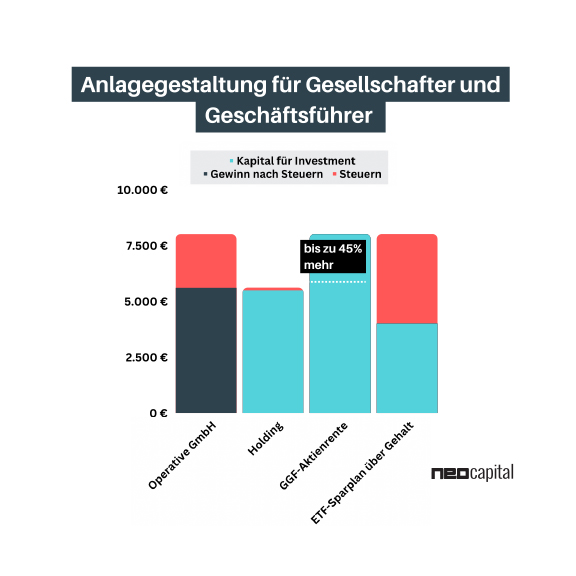
This guide refers to German law and the German tax system. It is a translation of our German original and does not replace individual tax or legal advice.
GmbH (German limited liability company) managing directors often earn well, but they also carry a particular risk: their income depends on the success of their own company, and anyone who is not subject to compulsory pension insurance receives no statutory pension from this activity in old age. At the same time, the GmbH as employer offers tax planning options that many managing directors do not make full use of.
This guide puts the most important options into context and shows the role played by status, tax and business risk. For an overview of our advisory services, see managing director protection & retirement planning.
Step 1: Are you subject to social security contributions?
According to the case law of the Federal Social Court (Bundessozialgericht, BSG), whether a managing director is an employee for social security purposes comes down to one clear question: can they decisively determine the company's affairs through their voting rights? The German Pension Insurance (Deutsche Rentenversicherung) summarises the principles as follows:
| Constellation | Status as a rule |
|---|---|
| Non-shareholder managing director (Fremdgeschäftsführer) | employed – subject to social security contributions |
| Shareholder-managing director with at least 50% of the share capital | self-employed – not subject to social security contributions |
| Minority shareholder with a comprehensive blocking minority in the articles of association | self-employed – not subject to social security contributions |
| Minority shareholder without such a blocking minority | employed – subject to social security contributions |
For managing shareholders of a GmbH, a status determination procedure (Statusfeststellungsverfahren) with the Deutsche Rentenversicherung is provided for (Section 7a SGB IV (Social Code Book IV)). The result should be available before the retirement strategy is set – because it determines whether pension contributions are paid and which subsidised routes are open.
- Subject to social security contributions: You acquire statutory pension entitlements, and your pension contributions reduce the scope for the basic pension. Occupational pension provision works as it does for other employees.
- Exempt from social security contributions: No statutory pension from this activity – in return, full freedom of design, but also full personal responsibility for retirement provision, occupational disability and surviving dependants.
Overview of occupational pension routes
For tax purposes, even a shareholder-managing director who is exempt from social security contributions is generally an employee of their GmbH. In principle, all five implementation routes of occupational pension provision (betriebliche Altersvorsorge, bAV) are therefore open to them. Three are particularly relevant for managing directors:
| Route | Tax framework | Typical use |
|---|---|---|
| Direct insurance (Direktversicherung), Pensionskasse, Pensionsfonds | Contributions tax-free up to 8% of the BBG (Section 3 No. 63 EStG) – 2026: €8,112 per year | Simple basic building block, also for non-shareholder managing directors |
| Support fund (Unterstützungskasse) | Allocations by the GmbH deductible as business expenses under Section 4d EStG; no inflow for the managing director | Higher contributions possible than with direct insurance, no burden on the balance sheet |
| Pension commitment (Pensionszusage, direct commitment) | Pension provision under Section 6a EStG; written commitment, valuation at a 6% discount rate | High level of provision, but balance-sheet and financing risk in the GmbH |
Direct insurance: the simple basic building block
The GmbH pays contributions into a direct insurance policy (Direktversicherung), which in 2026 are free of wage tax up to €8,112 per year. For managing directors subject to social security contributions, €4,056 of this is also free of social security contributions. The payout in retirement is fully taxed. Fund-linked tariffs with a high equity allocation are suitable for long investment horizons – low costs and a free choice of funds are what matter.
Support fund: higher contributions without balance-sheet risk
With a support fund, the GmbH makes allocations to an external pension institution, which later provides the benefits. Within the limits of Section 4d EStG, the allocations are business expenses; nothing accrues to the managing director until retirement. Because the obligation is outsourced, it does not burden the GmbH's balance sheet in the way a pension provision does. For shareholder-managing directors, it is therefore often an alternative to the pension commitment.
Pension commitment: effective, but demanding
The classic pension commitment by the GmbH allows high levels of provision and reduces profits via provisions. In practice, however, it has become a burden for many companies: the tax valuation at 6% differs significantly from the commercial balance sheet, commitments that are not fully funded make a company sale and succession more difficult, and for controlling shareholder-managing directors the tax authorities check strictly whether the commitment is appropriate and at arm's length. Otherwise there is a risk of a hidden profit distribution (verdeckte Gewinnausschüttung). A pension commitment should therefore only be set up with reinsurance and in close consultation with your tax adviser – and existing commitments should be reviewed regularly.
Insolvency protection: your retirement assets and business risk
For employees, the Pension Protection Fund (Pensions-Sicherungs-Verein) protects company pensions in the event of the employer's insolvency. Majority shareholder-managing directors are usually not covered. Anyone building up their retirement provision through their own GmbH should therefore make sure that the retirement assets are separated from business risk – for example by pledging a reinsurance policy to the managing director or by using external implementation routes such as direct insurance and the support fund.
Private building blocks: basic pension and freely available assets
In addition to occupational provision, the basic pension (Basisrente, "Rürup" pension) is an option for managing directors. In 2026, contributions of up to €30,826 (married couples €61,652) are deductible as special expenses (Section 10(3) EStG). For managing directors exempt from social security contributions, the scope is particularly large because no statutory pension contributions are offset against it. However: if the GmbH has granted a pension commitment, the maximum amount may be reduced by a notional pension insurance contribution (Section 10(3) sentence 3 no. 1(b) EStG) – this should be checked in advance.
Because all subsidised routes tie up capital until retirement, every managing director's plan should also include a freely available portion: a broadly diversified securities portfolio or rented property. These building blocks create flexibility – for example for an earlier exit or business succession. How entrepreneurs plan business and private assets together is shown in our guide financial planning for entrepreneurs.
Which combination suits whom?
| Situation | Sensible focus |
|---|---|
| Non-shareholder or minority managing director, subject to social security contributions | Statutory pension + direct insurance up to 8% of the BBG + freely available portfolio |
| Majority shareholder, GmbH with stable profits | Support fund or direct insurance + basic pension + freely available assets |
| Shareholder with an existing pension commitment | Review the commitment (full funding, reinsurance, suitability for succession), supplemented by freely available building blocks |
| Planned company sale or succession | Structure provision to be as balance-sheet-neutral and transferable as possible |
Checklist for managing directors
- Clarify your social security status or consider a status determination.
- Calculate your provision needs: what income will you need in retirement, and which entitlements already exist?
- Review existing commitments and contracts for costs, full funding and insolvency protection.
- Choose the implementation route and coordinate it with your tax adviser (appropriateness, balance-sheet effect).
- Plan in the basic pension and freely available assets as a supplement.
- Protect against occupational disability and provide for surviving dependants.
Frequently asked questions
Is a GmbH managing director subject to compulsory pension insurance?
Non-shareholder managing directors and minority shareholders without a comprehensive blocking minority are usually employed and therefore subject to compulsory insurance. Shareholder-managing directors with at least 50% of the shares or a comprehensive blocking minority in the articles of association usually are not.
How much can the GmbH pay into a direct insurance policy tax-free in 2026?
Up to 8% of the contribution assessment ceiling of the pension insurance, i.e. €8,112 per year in 2026 (€676 per month).
Does a pension commitment for managing directors still make sense?
It can make sense, but it is demanding: provisions, full funding, appropriateness and later succession must be properly regulated. Many shareholder-managing directors today prefer external routes such as the support fund or direct insurance.
Is my occupational pension protected if the GmbH becomes insolvent?
For employees, the Pensions-Sicherungs-Verein (Pension Protection Fund) steps in. Majority shareholder-managing directors are usually not covered – they should secure their entitlements, e.g. by pledging the reinsurance policy or by using external implementation routes.
Can I also take out a Rürup pension as a managing director?
Yes. In 2026, up to €30,826 (married couples €61,652) is deductible. Statutory pension contributions are offset against this; with a pension commitment, the maximum amount may be reduced.