
Vorabpauschale 2026: base interest rate 3.20%, calculation and calculator for ETFs and funds
This guide refers to German law and the German tax system. It is a translation of our German original and does not replace individual tax or legal advice.
Many investors only notice the Vorabpauschale when money leaves their account at the beginning of January even though they have not sold anything. This article shows how the lump sum is calculated, what changes in 2026 due to the higher base interest rate and which levers you have. You can work out your own figure with the calculator further down.
What is the Vorabpauschale?
Accumulating funds and ETFs do not distribute their income but reinvest it. So that investors cannot defer the tax until they sell, the state has taxed a notional minimum return every year since 2018: the Vorabpauschale (Section 18 InvStG (Investment Tax Act)). It counts as taxable investment income (Section 16 InvStG) and also affects distributing funds if their distributions are lower than the base return.
How the Vorabpauschale 2026 is calculated
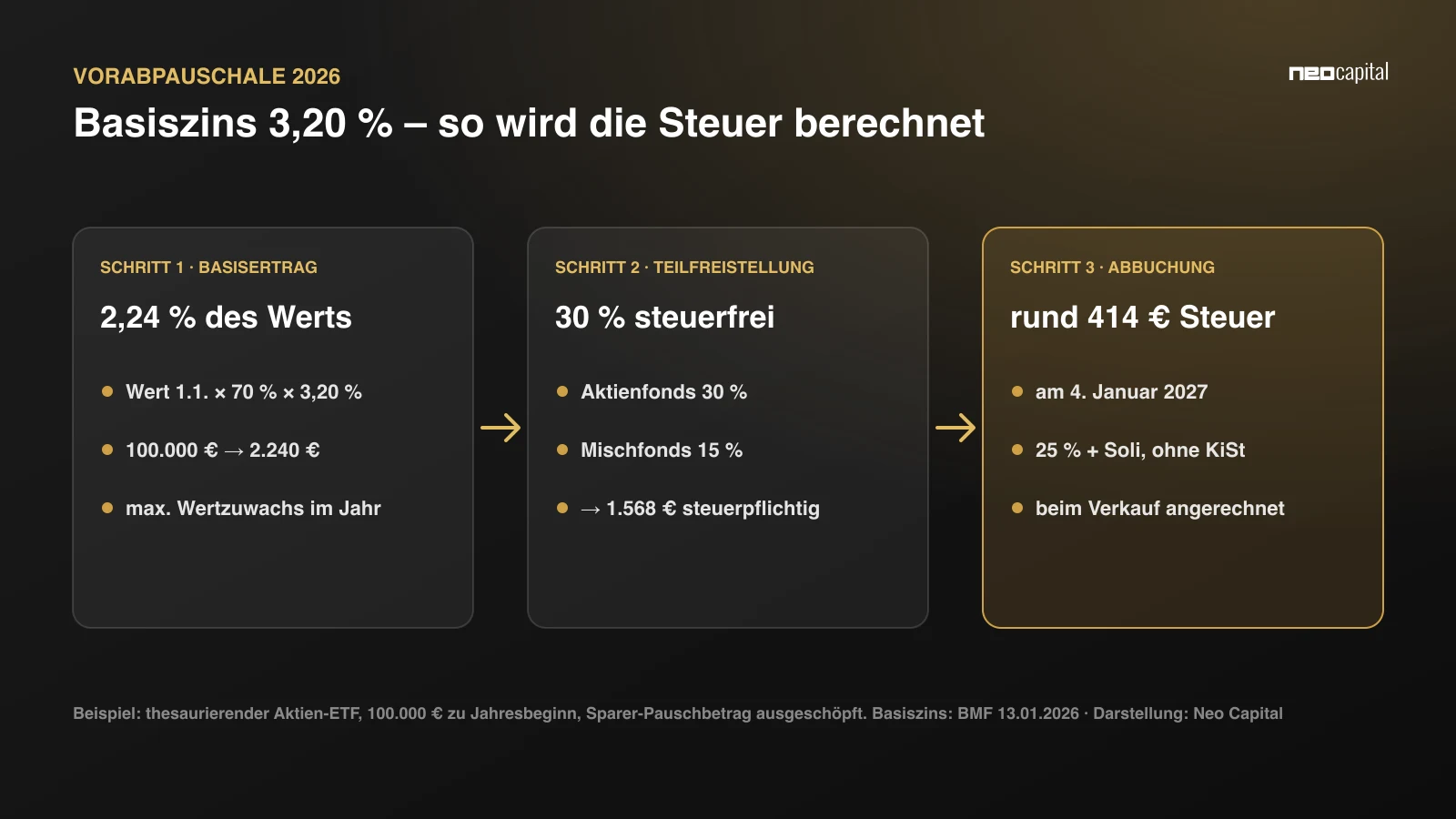
- Base return (Basisertrag): redemption price at the start of the year × 70% of the base interest rate. 2026: 70% × 3.20% = 2.24% of the value at the start of the year.
- Cap: The base return is limited to the actual increase in value during the year (first to last redemption price) plus distributions. If the fund falls, there is no Vorabpauschale.
- Deduct distributions: The distributions of the year are deducted from the (capped) base return. The result is the Vorabpauschale.
- Year of purchase: If the fund was bought during the year, the Vorabpauschale is reduced by one twelfth for each full month before the month of purchase (Section 18(2) InvStG).
- Partial exemption (Teilfreistellung): Part of it remains tax-free – 30% for equity funds, 15% for mixed funds, 60% or 80% for real estate funds (Section 20 InvStG).
- Tax: The remainder is subject to 25% flat-rate withholding tax (Abgeltungsteuer) plus 5.5% solidarity surcharge and church tax where applicable (Section 32d EStG), to the extent that the saver's allowance of €1,000 (€2,000 for joint assessment) has been used up (Section 20(9) EStG).
An equity fund is a fund that, according to its investment conditions, continuously invests more than 50% in equities; at least 25% makes it a mixed fund (Section 2(6) and (7) InvStG). An MSCI World ETF is therefore an equity fund with 30% partial exemption.
Base interest rate 2026 compared with previous years
| Year | Base interest rate | Base return per €100,000 | Tax on equity ETF* | Debit |
|---|---|---|---|---|
| 2023 | 2.55% | €1,785 | around €330 | January 2024 |
| 2024 | 2.29% | €1,603 | around €296 | January 2025 |
| 2025 | 2.53% | €1,771 | around €327 | 2 January 2026 |
| 2026 | 3.20% | €2,240 | around €414 | 4 January 2027 |
The base interest rate is derived from the yield on long-term German federal bonds on the first trading day of the year (Section 18(4) InvStG). Because yields on 15-year federal bonds have risen, the Vorabpauschale for 2026 is a good quarter higher than for 2025.
Worked example: €100,000 in an MSCI World ETF
| ETF rises by 7% | ETF rises by 1% | ETF falls | |
|---|---|---|---|
| Value 1 Jan 2026 | €100,000 | €100,000 | €100,000 |
| Value 31 Dec 2026 | €107,000 | €101,000 | €95,000 |
| Base return (2.24%) | €2,240 | €2,240 | €2,240 |
| Cap (increase in value) | €7,000 | €1,000 | €0 |
| Vorabpauschale | €2,240 | €1,000 | €0 |
| Taxable after 30% partial exemption | €1,568 | €700 | €0 |
| Flat-rate withholding tax 25% + solidarity surcharge | €413.56 | €184.62 | €0 |
Vorabpauschale calculator 2026
Basiszins 2026: 3.20% according to the BMF circular. If a fund was bought during the year, enter as the 1 Jan value the value of your units at the redemption price at the start of the year.
Your Vorabpauschale
- Base return (value 1 Jan × 70% × Basiszins)
- –
- Cap (increase in value + distributions)
- –
- Vorabpauschale
- –
- taxable after partial exemption
- –
- after saver's allowance
- –
- Flat-rate tax · Soli · church tax
- – · – · –
Simplified model calculation under Section 18 InvStG for one calendar year and one fund. The tax paid is credited on sale, because the Vorabpauschalen reduce the capital gain (Section 19(1) InvStG). Without the Günstigerprüfung (lower-rate assessment) and without loss offsetting. Not tax advice.
When and how is the tax debited?
The Vorabpauschale is deemed to be received on the first working day of the following year (Section 18(3) InvStG) – for 2026, according to the BMF, on 4 January 2027. Your custodian bank then pays the tax over automatically. If there is not enough money in the settlement account, the bank may collect the amount from another account you hold with it without your consent and may also use an agreed overdraft facility, unless you have objected to this beforehand (Section 44(1) sentences 7–9 and (1b) EStG). If that does not work, the bank reports the case to the tax office, which then claims the tax via your tax return.
No double taxation on sale
The Vorabpauschale is an advance payment, not an additional tax. When you sell the fund, the capital gain is reduced by all Vorabpauschalen recognised during the holding period (Section 19(1) InvStG). So overall you do not pay more tax – only earlier. The disadvantage lies in compound interest: the money used for the tax is no longer working in the portfolio.
How can the Vorabpauschale be reduced?
In a normal securities account the Vorabpauschale cannot be avoided, but it can be managed well. The most important levers:
- Allocate your exemption order (Freistellungsauftrag) correctly: The saver's allowance of €1,000 (€2,000 for joint assessment) also applies to the Vorabpauschale. If you hold accounts with several banks, the exemption order should be placed where the income arises (Section 44a EStG).
- Non-assessment certificate (NV-Bescheinigung): Anyone whose total income is below the basic tax-free allowance – for example students, children or pensioners with low income – can avoid the tax deduction entirely with a non-assessment certificate. It is valid for a maximum of three years.
- Most-favourable assessment (Günstigerprüfung): If your personal tax rate is below 25%, you can apply for the most-favourable assessment in your tax return (Section 32d(6) EStG). It then applies to all capital income.
- Consider the fund type: Equity funds with 30% partial exemption are more favourable for tax purposes than bond ETFs without partial exemption. However, the split between equities and bonds should follow your strategy, not tax.
- Portfolio for children: Children have their own basic tax-free allowance (2026: €12,348, Section 32a EStG) and their own saver's allowance. With a non-assessment certificate, the Vorabpauschale on a child's portfolio usually remains tax-free. Prerequisite: the assets genuinely belong to the child.
- Insurance wrapper and subsidised pension provision: No Vorabpauschalen are recognised for funds held in a unit-linked insurance policy, in occupational pension schemes or in certified Riester and Rürup contracts (Section 16(2) InvStG). Whether this is worthwhile depends on the costs of the contract and the later taxation.
- Distributing funds: Distributions reduce the Vorabpauschale but are taxed themselves. For tax purposes this is usually a zero-sum game – switching is only worthwhile for strategic reasons, not for tax reasons.
Will anything change in the Vorabpauschale in 2026 or 2027?
As of November 2026, Section 18 InvStG is unchanged; there are no plans to abolish the Vorabpauschale. New from 2027 is state-subsidised private pension provision with a pension savings account (Altersvorsorgedepot, under the Altersvorsorgereformgesetz). We will examine exactly how the Vorabpauschale and the subsidy interact there as soon as providers present their products.
What we review for you at Neo Capital
The Vorabpauschale is rarely the biggest tax issue in a portfolio – but it is a good occasion to review the structure: Are exemption orders allocated correctly? Does the fund selection match the partial exemption? Should children's portfolios, an insurance wrapper or an asset-holding company play a role? We calculate this with you and coordinate tax questions with your tax adviser. Why taxes only come after strategy and portfolio is shown on our page Is a financial advisor worth it? (in German).
Frequently asked questions
What is the base interest rate 2026 for the Vorabpauschale?
3.20%. The Federal Ministry of Finance (BMF) published the figure on 13 January 2026. The base return is therefore 70% × 3.20% = 2.24% of the fund value at the start of the year.
When will the Vorabpauschale 2026 be debited?
It is deemed to be received on the first working day of the following year, according to the BMF on 4 January 2027. The custodian bank debits the tax from the settlement account in the first days of January.
How much Vorabpauschale do I pay on €100,000 in an ETF?
For an accumulating equity ETF worth €100,000 at the start of the year, the Vorabpauschale 2026 is up to €2,240. After 30% partial exemption, €1,568 is taxable; this results in €413.56 flat-rate withholding tax and solidarity surcharge if the saver's allowance has already been used up.
Is the Vorabpauschale also due if the ETF is in the red?
No. The Vorabpauschale is capped at the increase in value during the calendar year. If the fund is worth less at the end of the year than at the beginning, no Vorabpauschale arises.
Do I pay tax twice because of the Vorabpauschale?
No. On sale, the gain is reduced by all Vorabpauschalen already taxed (Section 19(1) InvStG). The Vorabpauschale is an advance tax payment.
What happens if there is no money in the settlement account?
The bank may collect the amount from another account you hold with it and use an agreed overdraft unless you have objected beforehand. Otherwise it reports the case to the tax office, which collects the tax via your tax return.