
RSUs, ESOP and stock options in Germany: how employee equity is taxed
This guide refers to German law and the German tax system. It is a translation of our German original and does not replace individual tax or legal advice.
Whether you work for a global tech company or a Berlin start-up, equity compensation is often a significant part of your income. Its tax treatment in Germany differs from your monthly salary – and RSUs, stock options, ESPP and virtual shares are treated very differently. This guide explains the rules under German law, with worked examples for 2026.
Overview: types of employee equity
| Type | When is it taxed? | How? |
|---|---|---|
| RSUs (restricted stock units) | at vesting / delivery of the shares | employment income: wage tax + social security |
| Stock options | on exercise, not on grant | employment income on market price minus strike price |
| ESPP (discounted share purchase) | on purchase | employment income on the discount |
| VSOP / virtual shares | on payout | employment income on the payment |
| Real start-up equity (section 19a) | deferred until sale, job change or 15 years | employment income, possibly one-fifth rule |
| Later gains on all shares | on sale | flat tax 25 % + solidarity surcharge |
RSUs: taxed at vesting
With RSUs you first only hold a right to shares. Nothing is taxed while restrictions apply. The benefit is received when you obtain economic ownership – usually when the shares are booked into your account (BMF letter of 12.12.2023, paras. 274, 296 f.). It is valued at the share price on that date; later price changes do not change the taxable amount.
- Withholding: Even if the foreign parent company grants the RSUs, the German employer generally has to withhold wage tax (BMF, para. 301). Often shares are sold automatically to cover the tax ("sell to cover").
- Social security: RSUs count as earnings. If your salary already exceeds the 2026 contribution ceilings (69,750 € for health/care, 101,400 € for pension/unemployment), no extra contributions apply.
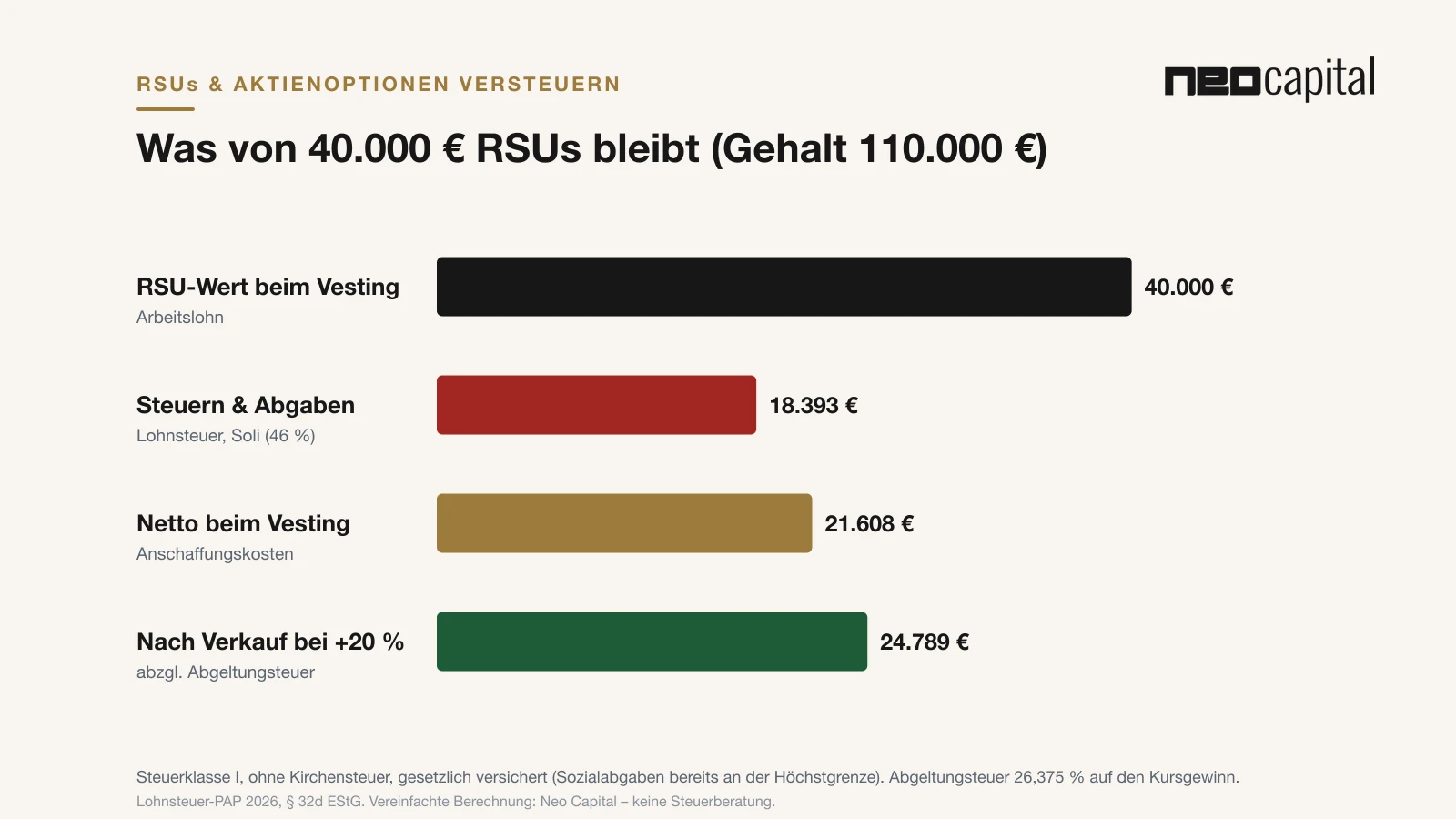
- Cost basis: The value taxed at vesting becomes the acquisition cost of the shares. Only later gains are taxed again on sale.
RSU calculator 2026: what you keep
Enter your base salary and the value of the RSUs vesting this year. The calculator shows the additional taxes and social security, the net value at vesting and – depending on the share price – what is left after a later sale.
Your RSUs after tax
–
Net value at vesting
- Wage tax, Soli & church tax on the RSUs
- –
- Social security on the RSUs
- –
- Total burden on the RSUs
- –
- Value at sale
- –
- Capital gain / loss
- –
- Flat-rate tax on the gain (26.375 %)
- –
- You keep after sale
- –
- Possible tax saving with Fünftelregelungonly if the conditions are met – see article
- –
Simplified annual calculation for 2026 (wage tax plan 2026, flat-rate tax incl. Soli, no church tax on capital gains, no allowance). Not tax advice.
| Example | Taxes & contributions on the RSUs | Net at vesting |
|---|---|---|
| 90,000 € salary + 30,000 € RSUs | 14,701 € (49.0 %) | 15,299 € |
| 110,000 € salary + 40,000 € RSUs | 18,393 € (46.0 %) | 21,608 € |
| 150,000 € salary + 100,000 € RSUs | 44,310 € (44.3 %) | 55,690 € |
Stock options, ESPP and virtual shares
- Stock options: Neither the grant nor the first possibility to exercise triggers tax – only the actual exercise (Federal Fiscal Court BFH, 20.06.2001, VI R 105/99; BMF, para. 274). The difference between market value and strike price is employment income.
- ESPP: The purchase discount is employment income. Up to 2,000 € per year can be tax-free if the plan is open to all employees with at least one year of service (section 3 no. 39 EStG).
- VSOP / phantom shares: You receive a cash payment linked to the company value, not shares. The payout is fully taxable employment income – without the flat capital gains tax on the increase in value (BMF, para. 289).
- Start-ups (section 19a EStG): For real shares in young, smaller companies, taxation can be deferred until sale, end of employment or at the latest 15 years (section 19a EStG). The deferral must be chosen in payroll with the employee's consent.
Does the one-fifth rule help?
Remuneration for work over several years can be taxed at a reduced rate under the "Fünftelregelung" (section 34 EStG). The BFH has applied it to stock options where more than twelve months lie between grant and exercise (BFH, 18.12.2007, VI R 62/05). There is no specific case law for RSUs. Since 2025, the relief is only granted in the annual tax return, not in payroll.
| Example | Possible saving |
|---|---|
| 110,000 € salary + 40,000 € RSUs | 0 € |
| 60,000 € salary + 80,000 € RSUs | 3,466 € |
| 40,000 € salary + 120,000 € RSUs (part-time, sabbatical) | 9,115 € |
If your other income is already in the top bracket, the one-fifth rule brings nothing. It mainly pays off in years with lower salary, for example parental leave, a sabbatical or when options are exercised after leaving the company.
After vesting: hold or sell?
- Capital gains: Gains above the value taxed at vesting are subject to 25 % flat tax plus solidarity surcharge (section 32d EStG); the saver's allowance is 1,000 € (2,000 € for married couples, section 20 (9) EStG).
- Losses: If the price falls below the vesting value, the loss can only be offset against gains from shares. The wage tax already paid is not refunded.
- Foreign brokers: US brokers do not withhold German tax. Gains and dividends must be declared in your German tax return; US withholding tax on dividends is credited up to 15 %.
- Concentration risk: Your salary, career and RSUs depend on the same company. A regular selling plan and diversification reduce this risk – selling right after vesting usually triggers little tax because no gain has arisen yet.
- Moving countries: If you worked in several countries during the vesting period, the income is generally split by working days between grant and vesting (BMF, paras. 282, 299). Keep a record of your working days per country.
We help employees turn their equity into a diversified portfolio – with an investment strategy that takes the risk of your employer into account. Advice is available in English. Contact us.
Frequently asked questions
When are RSUs taxed in Germany?
At vesting, when the shares are delivered to your account – not at grant. The share value on that date is employment income subject to wage tax and possibly social security.
Are RSUs taxed again when I sell?
Only the gain since vesting. The value taxed at vesting is your cost basis. The gain is subject to 25 % flat tax plus solidarity surcharge.
Does the one-fifth rule apply to RSUs?
The BFH has applied it to stock options with more than twelve months between grant and exercise. There is no specific case law for RSUs. With a high base salary it brings little or nothing anyway.
How are virtual shares (VSOP) taxed?
The payout is fully taxable employment income subject to social security. There is no flat capital gains tax on the increase in value.