
Special Depreciation under Section 7b EStG and Declining-Balance Depreciation (2024): The Changes Awaiting Investors
This guide refers to German law and the German tax system. It is a translation of our German original and does not replace individual tax or legal advice.
The Growth Opportunities Act (Wachstumschancengesetz) was passed by the Bundesrat (Germany's Federal Council) on 22.03.2024, sending investors into a state of euphoria. Anyone who has studied the content of the legislation will have recognised the potential of the changes to Section 7b of the German Income Tax Act (EStG, Einkommensteuergesetz). To channel more money into the construction of new flats, investors are to receive attractive incentives in future through declining-balance depreciation (degressive AfA, from AfA — Absetzung für Abnutzung, depreciation for wear and tear) and special depreciation (Sonderabschreibung) of the property. In this article, we reveal what this form of depreciation is all about, which properties are suitable for acquisition or construction and how you can specifically benefit from the massive tax savings. We also give an outlook on the actual savings arising from the planned depreciation.
Neo Capital supports employees and entrepreneurs in structuring their wealth building optimally for tax purposes. Using the tax savings achieved by our clients, we develop a data-based concept for the long-term investment of your assets. In this way, we convert your tax liabilities into private wealth via the Investitionsabzugsbetrag (IAB, investment deduction), high-yield properties and tax-privileged investments.
Important: both forms of depreciation apply only to let residential property and, unfortunately, are currently entirely unavailable to owner-occupiers.
The legislator's plans and what they mean for the property market
The past financial year was a year of waiting for most property investors. Anyone who held back in view of higher interest rates is getting a new tailwind from a recent legislative decision. As part of the Growth Opportunities Act, the German legislator plans to amend Section 7b EStG in investors' favour. The new provision stipulates that, in addition to the increase in straight-line depreciation from two to three per cent and the special depreciation for climate-friendly properties, declining-balance depreciation is also set at five per cent.
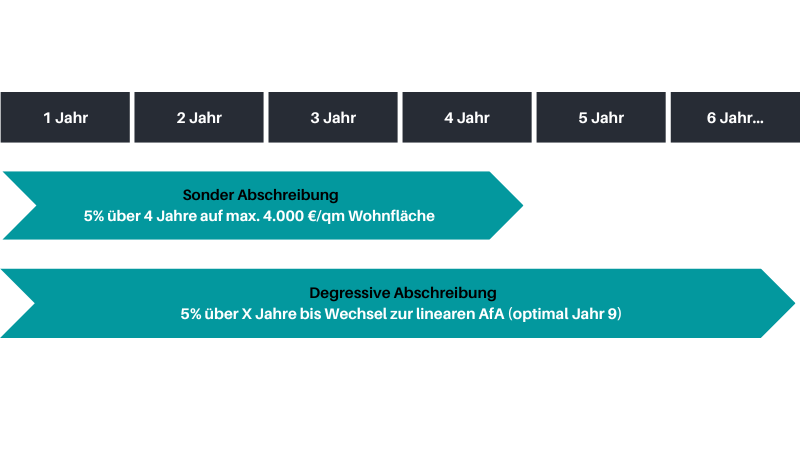
Special depreciation and declining-balance depreciation can be combined for properties with an efficiency house standard (Effizienzhaus-Standard) of at least 40 (important: with the QNG-Plus seal). As a result, depreciation of up to 10% per year at the outset, or 38.55% in the first 4 years alone, is possible. With this optimisation, the legislator aims to promote the construction of energy-efficient housing and make acquisition more attractive for investors. The background to this is the persistently high demand for rental housing in cities and the lack of new construction due to the current market and interest rate situation. However, anyone wishing to depreciate the acquisition or construction costs of their property in accordance with the new draft must meet requirements that expose taxpayers without adequate advice to the risk of possible repayments.
Direct tax savings through special depreciation
Provided the relevant requirements are met, special depreciation leads to drastic tax savings in the first years after acquisition. Before we turn to an example, however, you should know the framework conditions for special depreciation. Only those who comply with the ten-year period and the construction cost cap avoid possible repayments. This means that even owner-occupation of the property before the ten-year period has expired, or a tax-free sale, can cause tax refunds obtained to become retroactively invalid. The situation is similar with the construction cost cap: the acquisition or construction costs must not exceed €5,200 per square metre. Subsequent acquisition costs incurred in the first three years should also be taken into account here, which leads to precise calculations by developers and investors. Important: acquisition costs also include the costs of the notary, the land registry and the real estate transfer tax (Grunderwerbsteuer). Failure to comply with these requirements can result in interest being charged on the tax liability and an additional payment equal to the special depreciation.
- Term: declining-balance depreciation until the end of the term, special depreciation under Section 7b four years
- Amount: both variants 5% per year (for declining-balance depreciation, the residual book value must be taken into account)
- Minimum criteria: declining-balance depreciation – efficiency house standard KfW 55, purchase agreement legally concluded between 1.10.2023 and 30.9.2029, acquisition by the end of the year of completion; special depreciation under Section 7b – efficiency house standard 40 with QNG sustainability certificate
- Construction cost cap: declining-balance depreciation none, special depreciation under Section 7b €5,200/m² gross floor area (BGF, Bruttogrundfläche)
- Special features: for declining-balance depreciation there is an option to switch to straight-line depreciation under Section 7(4) EStG, and extraordinary wear and tear cannot additionally be deducted during declining-balance depreciation; the assessment basis for special depreciation under Section 7b has been increased to €4,000/m² of living space, whereby the gross floor area rather than the pure living space is decisive; for both variants, acquisition costs also include notary, land registry and real estate transfer tax costs
Declining-balance depreciation and special depreciation under Section 7b EStG
The combination of declining-balance depreciation and special depreciation under Section 7b EStG results in a clear advantage for investors: thanks to depreciation, the income-surplus calculation shows considerably larger deductions, which lead to an above-average tax saving in the same year. In the year of acquisition alone, this combination provides up to 10% depreciation, meaning that up to 40% of the acquisition can be depreciated in the first 4 years. Apart from special depreciation and the investment deduction, there is currently no comparable option that allows more than 20% of the investment costs to be recovered via the tax return at the marginal tax rate. Model example of declining-balance depreciation – residual book value:
- Year 1: 5% of €500,000 = €25,000
- Year 2: 5% of €475,000 = €23,750
- Year 3: 5% of €451,250 = €22,562
- Year 4: 5% of €428,688 = €21,434
- Year 5: 5% of €407,254 = €20,363
- Year 6: 5% of €386,891 = €19,345
Result: the investor can thus claim around €132,000 for tax purposes (meaning no tax has to be paid on this amount). Particularly in comparison with existing buildings, it becomes clear that the tax advantage represents a massive boost to your nominal return. The comparison between the straight-line depreciation of an existing property and the combination of declining-balance depreciation and special depreciation can be illustrated using a purchase price with a building share of €400,000:
- 5% declining-balance depreciation alone: maximum tax refund after 10 years up to €55,000, corresponding to up to 13% of the acquisition costs
- Combined with special depreciation under Section 7b: maximum tax refund after 10 years up to €80,000, corresponding to up to 20% of the acquisition costs (Neo Capital's own example calculation)
Acting quickly pays off: how to benefit from the change
Energy-efficient buildings from efficiency house standard 55 qualify for declining-balance depreciation. The depreciation rates in the first years add up to 26.49% here (5.00 | 4.75 | 4.51 | 4.29 | 4.07%) — an advantage of 8.49% over straight-line depreciation of 3% p.a. With a holding period of 10 years, this results in an average additional annual depreciation of 4.01 percentage points. Anyone wishing to take advantage of this depreciation should seek advice on suitable properties promptly. The reason for this lies in the rising demand from investors who also want to benefit from this arrangement. As a result, rising property prices are to be expected. Companies thus inevitably benefit from the demand of new investors and prospective buyers wishing to meet the requirements for special depreciation under Section 7b of the Income Tax Act. In addition to efficiency house standard 55, construction of the building must have begun between 01.10.2023 and 30.09.2029. Anyone who concludes a legally binding purchase agreement within the same period can benefit from declining-balance depreciation of five per cent. Since numerous residential buildings that have been built or are under construction already meet these requirements, prospective buyers can already enter into discussions with qualified intermediaries. To also be able to use special depreciation without the risk of repayment or further hurdles, specialised companies should be entrusted with this task.
Neo Capital: your partner for tax-optimised investments
As you can see, after the investment slump of recent years, special depreciation is an attractive tool for buying sustainably constructed residential buildings in a tax-optimised way. In addition to the generally known advantages of a tax-free sale after 10 years and the value appreciation of property, significant advantages arise as early as the year of acquisition or construction. Finally, the tax-conscious switch to straight-line depreciation should be mentioned, which remains available under the current draft legislation. Anyone who takes care of structuring their investment down to this detail can rapidly expand their portfolio against the background of the Growth Opportunities Act. Would you like advice on converting your tax liabilities into private wealth? We explain individually and independently which investment decisions are optimal in light of current legislation and on the basis of your situation. We also look after you on a long-term and comprehensive basis on the subjects of wealth building, management and provision. Talk to us about the opportunities of special depreciation for your investment: together with our network of tax advisers and financial experts, we look forward to establishing a tax-optimised provision structure for you.
Frequently asked questions
How does the Growth Opportunities Act affect me?
As an investor, the draft legislation brings extensive advantages, particularly for buying new builds. Special depreciation and declining-balance depreciation of five per cent per year are two features that influence the level of your return and your tax savings per year. Combined, investors achieve up to 10% depreciation in the first years, meaning that within one financial year up to 10% of the tax on the acquisition or construction costs is returned. At the top marginal tax rate, including the solidarity surcharge (Solidaritätszuschlag) and church tax where applicable, this generates a high tax refund of almost 50%.
What do I need to bear in mind in the year a property is acquired?
In principle, buildings from efficiency house standard 55 qualify for declining-balance depreciation. Furthermore, the property cannot be used for owner-occupation within the first 10 years (ten-year period) if the increased depreciation has been claimed. When claiming special depreciation, efficiency house standard 40 with the QNG seal must be ensured. In addition, investors should observe the construction cost cap in order to avoid possible repayments and interest on the tax. We recommend appropriate advice from an independent expert on special depreciation and the investment deduction.
When must the property be built to qualify for the full investment deduction?
To depreciate up to 40 per cent in 4 years, construction of the residential building must have begun between 01.10.2023 and 30.09.2029. A legally effective purchase agreement for the property must have been concluded within the same period. We will be happy to advise you independently on the other requirements for special depreciation.
What changes have there been to declining-balance depreciation?
In the early draft of the Growth Opportunities Act, declining-balance depreciation was set at six per cent. With the resolution of 22.03.2024, this value was reduced to five per cent. The depreciation rates in the first 10 years add up to 40.13%: year 1: 5%, year 2: 4.75%, year 3: 4.51%, year 4: 4.29%, year 5: 4.07%, year 6: 3.87%, year 7: 3.67%, year 8: 3.49%, year 9: 3.32%, year 10: 3.15%. With a holding period of 10 years, this results in an average additional annual depreciation of 4.01 percentage points.
Is declining-balance depreciation possible despite construction starting before 01.10.2023?
The start of construction is decisive in the "construction case" (Herstellungsfall). In the acquisition case, the binding purchase agreement must have been concluded after 30.9.2023. For properties under construction where building began before 01.10.2023, the question therefore always arises as to whether the "buyer" according to the deed is, in economic terms, a buyer or a producer or developer (Bauherr). This depends on who bears the construction risk. In such cases this typically lies with the seller, so that an "acquisition case" (Anschaffungsfall) should apply. To settle the question conclusively, a closer look must be taken at the contract documents to determine when possession, benefits and burdens are to pass.
When does declining-balance depreciation or special depreciation under Section 7b start?
Depreciation can only begin once the property has been completed; letting is not relevant for the start of depreciation. Declining-balance depreciation is applied pro rata temporis, whereas special depreciation is not. This means: if the property was completed in November 2024, special depreciation under Section 7b EStG of up to 5% can be used for the year 2024. Special depreciation is therefore not only taken into account pro rata at 2/12, as is the case with straight-line or declining-balance depreciation.