
Private health insurance on the basis of high income: when switching pays off
This guide refers to German law and the German tax system. It is a translation of our German original and does not replace individual tax or legal advice.
In Germany, health insurance is one of the largest cost items on many employees' monthly payslips. Yet even well-paid employees are often found in statutory health insurance (GKV, gesetzliche Krankenversicherung), even though they meet the requirements for switching to private health insurance (PKV, private Krankenversicherung). In this article, we explain whether choosing private health insurance pays off for employees with high incomes. We also show you which challenges and conditions come with switching to private health insurance. After reading our article, you will know from when you can be privately insured and how the premium can be optimised through sufficient preparation.
As an independent financial advisory firm, Neo Capital is the first choice for well-paid employees and self-employed people. We support our clients in investing assets in a tax-optimised way and protect their individual situation with proven insurance concepts. In this way, we provide comprehensive support to ambitious employees and self-employed people in building wealth and protecting against everyday risks. Together with our team and modern software, we analyse your situation and show you clear opportunities for a better financial future.
Private health insurance – how premiums and benefits have developed
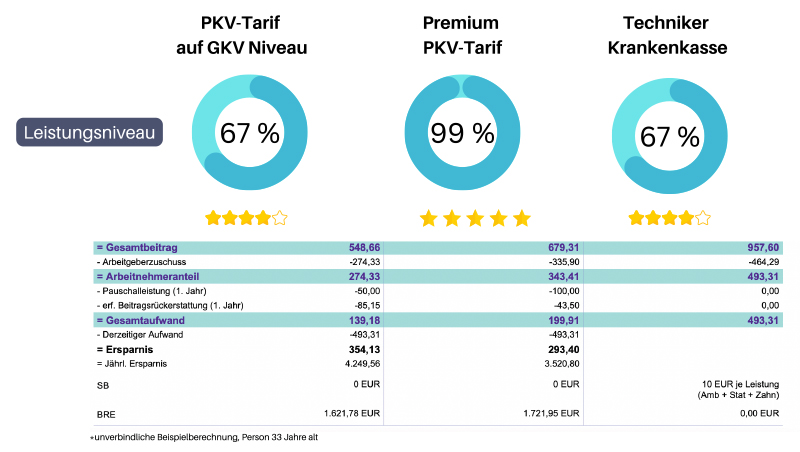
For more than 50 years, statutory health insurance has been characterised above all by one trend: rising contributions. Since 1970, there has been an average contribution increase of 5.75% p.a., driven by an ever-ageing population and fewer contributors. Since 1 July, the long-term care contribution in the GKV has risen and now depends on the number of children (table attached – source: AOK-Bundesverband GbR). The maximum contribution for an employee without children, for example, is now €1,007.48 (AOK Baden-Württemberg). The group of well-paid employees plays a decisive role here. It is this group that contributes a large share of the contributions through maximum rates and sometimes drastic back payments. Well-paid employees and self-employed people therefore not only pay for the protection of their own risk, but also contribute disproportionately to the common good of the other insured persons. This discrepancy already becomes apparent from an annual income of around €66,600 and should be reason enough to look into the options offered by private health insurance. In private health insurance, premiums rise by an average of 2.8% p.a., considerably more slowly than can be observed in statutory health insurance. In addition, many insured persons value the high quality of benefits and the sometimes lower premiums for families. The premium here often falls below that of statutory health insurance. Whether a switch makes sense for cost reasons should always be considered individually. In view of the development of premiums and the comparison of benefits, private health insurance is a much more attractive choice for most well-paid employees and self-employed people. You can find out more about the right time to join private health insurance in this article.
Switching to private health insurance and back to statutory health insurance
One argument many employees make against switching to cost- and benefit-optimised private health insurance is the question of returning to statutory health insurance. The fear of having no way back is often the reason why employees turn down a possible switch. Yet this is a stubborn myth that has persisted in our society for decades. The fact is that if the high annual income or employment is lost, a return to statutory health insurance is possible. Up to the age of 55, this can be done without effort, and there are also numerous options beyond that age with special requirements. If your personal income is below the requirements for private health insurance, employees can still take action. Since switching to private health insurance should be the aim in most cases, your personal state of health can be frozen by means of an option entitlement (Anwartschaft). This allows applicants to focus entirely on meeting the financial requirements while the door to private health insurance is kept open. Every ambitious employee or self-employed person should show at least this minimum of commitment in order to be free to arrange their health cover as they wish. To secure protection before entering working life, students without their own income can also use this option entitlement for the best possible insurance cover in the future.
Neo Capital: your route into private health insurance
There are many reasons to take out private insurance. Whether it is the sometimes lower premium, the considerably better insurance benefits or a view to your personal future: we accompany ambitious employees and self-employed people on the way to setting up their insurance optimally. To get the best out of every consultation individually with our clients, we refrain from pushy sales conversations and put the no-obligation choice of insurers first. We can make precise calculations of value for money, including an after-tax view, without losing sight of your individual family situation. What makes us unique is that we take tax aspects into account. We combine insurance with components in such a way that up to 80% of it can be deducted from tax. Are you interested in private health insurance and would like to take your health into your own hands? Then an individual consultation with one of our experts is a good idea. Based on all insurers and packages, we calculate your optimal entry into private health insurance. To do this, we look at more than 20 providers and more than 2,000 tariff combinations so that we can give you an independent and transparent recommendation. Start saving money every month by switching from statutory health insurance to a private health insurer and set up your wealth for the long term. We are your partner for professional, long-term structures for personal provision and wealth building.
Frequently asked questions
Is it possible to return to statutory health insurance?
Yes, up to the age of 55 a switch from private health insurance to statutory health insurance is possible without any problems. Beyond that, there are also ways for you to return to statutory health insurance. While a return to the GKV is almost always possible, the door to private health insurance can close quickly. We advise you on how you can take out private insurance despite rising insurance contributions.
How are statutory health insurance contributions developing?
Over the past 50 years, contributions have risen by an average of 5.75% p.a. The regular subsidies for health insurance have long been insufficient, which shifts the financing onto the shoulders of well-paid employees. As a result, your own contribution no longer just covers your personal protection, but rather the multi-billion deficit of statutory health insurance. A trend continues to emerge of rising contributions accompanied by a partially declining level of benefits.
What income do I need to switch to private health insurance?
To join private health insurance, a gross income of more than €66,600 is required. This corresponds to €5,550 a month (as of 2023) and is not unusual, particularly for civil servants, ambitious employees and self-employed people. Members of statutory health insurance should seek advice on joining private health insurance at the latest once they reach this annual income, in order to reduce their contribution burden and receive better insurance benefits.
What makes the GKV even less attractive for self-employed people
As a self-employed person, you have no employer who would cover half of the GKV contribution – so you pay 100% of the health insurance contribution yourself. As an employee in the GKV, your employer covers 50% of the contribution. Note that income from investments and letting is also included, which can quickly drive up the contribution.
How likely is it that GKV contributions will continue to rise more sharply than PKV premiums?
People in Germany are living longer and longer, while the number of young people keeps falling. Both the healthcare system and society in Germany are affected by the country's demographic change. The average life expectancy is 83.5 for women and 78.6 for men – that is 40 years more than in 1881, the year in which Bismarck introduced statutory health insurance. As people in Germany grow older, demand for healthcare services also rises. Chronic illnesses, dementia or the occurrence of several illnesses at the same time (multimorbidity) cause ever higher costs, which will place an increasing burden on the healthcare system. Experts forecast losses in the billions for health insurers over the coming decades. These will only be mitigated by long-term contribution increases. Younger insured persons are already feeling the effects of higher GKV contributions. At the same time, we must expect rising costs and lower benefits in the future. Private health insurance can protect you from the direct effects of demographic change, because through your premiums you can prepare for your own retirement and become less dependent on the number of young insured persons.