
The Right Time for Private Health Insurance as an Employee
This guide refers to German law and the German tax system. It is a translation of our German original and does not replace individual tax or legal advice.
Private health insurance (PKV) is particularly well known among the self-employed and freelancers. Yet many myths and prejudices surround PKV, which, thanks to its high level of benefits, is just as worthwhile for employees. In this article, we explain from when employees can switch to private health insurance and what to bear in mind when switching.
Neo Capital is your point of contact for insurance and pension products for high-earning employees. We support civil servants, the self-employed, freelancers and high-earning employees on the way to optimal provision and advise you without obligation on your individual situation.
How to switch successfully to private health insurance
Anyone who uses the benefits of statutory health insurance (GKV) via their employer forgoes numerous advantages of private insurers: unrestricted choice of doctor, faster appointments and more specialised treatment methods and medication. In addition to better benefits, a second advantage lies in saved contributions – anyone who switches to PKV with a gross income of more than €69,300 has usually been paying the statutory maximum rate. The difference saved compared with the PKV premium can be invested tax-efficiently and profitably; over the period up to retirement age, the compound interest effect creates private wealth that should not be underestimated. For many employees, switching to PKV is therefore often even cheaper or equally expensive in the long term – with a significantly higher level of benefits.
Entry threshold €69,300 gross (as of 2024)
While the self-employed and freelancers can switch without any financial requirements, employees in Germany need a gross income of more than €69,300 to join PKV (as of 2024, excluding commission and bonuses). Those with a lower income who still want to qualify for admission can use an Anwartschaft (option to switch later) to freeze their current state of health until the time of admission – a later switch on the basis of the historically healthy condition thus remains possible, even if illnesses or stricter health questions arise in the meantime. As around 15% of all those wishing to switch can no longer do so due to pre-existing health conditions, securing your health status in this way is an important instrument. Switching late after reaching the income threshold, on the other hand, brings only disadvantages – up to and including losing the chance to join if new illnesses occur.
Neo Capital: your health optimally insured
To cover all individual risks when selecting a tariff, we support you as independent advisers with years of expertise and point out attractive tax and investment opportunities for the contributions you save. For the self-employed, freelancers and high-earning employees, we filter from around 20,000 possible tariff combinations and also take into account the financial strength of the insurer. To select the best tariff and the free funds for investment, we use modern analysis software to advance your private wealth building through switching to PKV.
Frequently asked questions
When is it worth switching to PKV?
As soon as your gross income exceeds €66,600 (as of 2023), switching to private health insurance can be worthwhile. We will be happy to advise you on the requirements and options for switching, or on securing the option to switch through an Anwartschaft.
What advantages does PKV offer an insured person?
Private health insurance offers maximum medical care, free choice of doctor and various premiums. Compared with statutory health insurance, insured persons usually enjoy immediate appointments, high-quality treatment and better conditions. In addition, employees with PKV can save tax and build their wealth sustainably.
How do I know who can take out private insurance?
Entry into private health insurance is subject to certain requirements. In addition to a gross income of at least €66,600, the health questions are decisive for admission. We advise you on the admission options and on how to invest saved contributions tax-efficiently.
How have contributions to GKV and PKV developed over the last 10 years?
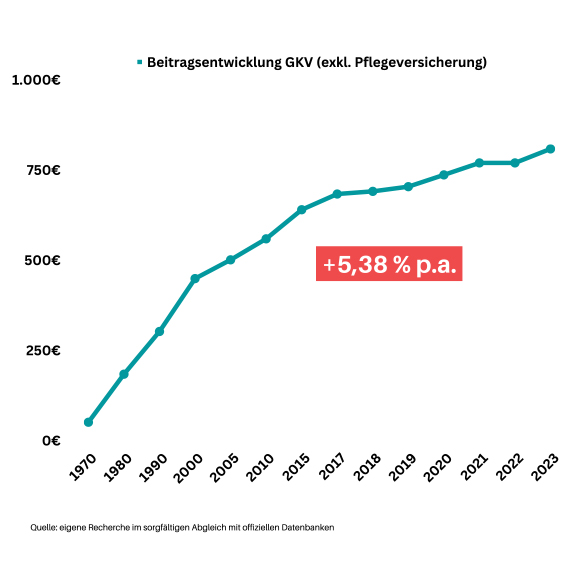
Statutory health insurance contributions have risen by an average of 3.4% p.a. over the past 10 years. Privately insured persons paid less, with an average increase of 2.8% p.a., while the quality of benefits did not decline.
What contribution increases are planned for GKV in the coming years?
The announced contribution increase for 2023 and 2024 is intended to partially offset the multi-billion deficit of statutory health insurance. Contributions will rise by at least 0.2 to 0.4 percentage points – a continuing trend of rising contributions for the same benefits.