
Top Retirement Planning Products: Find the Optimal Solution for Your Retirement
This guide refers to German law and the German tax system. It is a translation of our German original and does not replace individual tax or legal advice.
The right retirement planning products are crucial for a carefree retirement. Only those who start structuring their provision in good time will be able to maintain their accustomed standard of living in retirement. Given the wide range of retirement products, we would like to summarise the most important aspects of this topic and explain which product is optimal for your situation. Afterwards, you will know why retirement planning is one of the most important tasks in your private life and how you can ideally structure your provision.
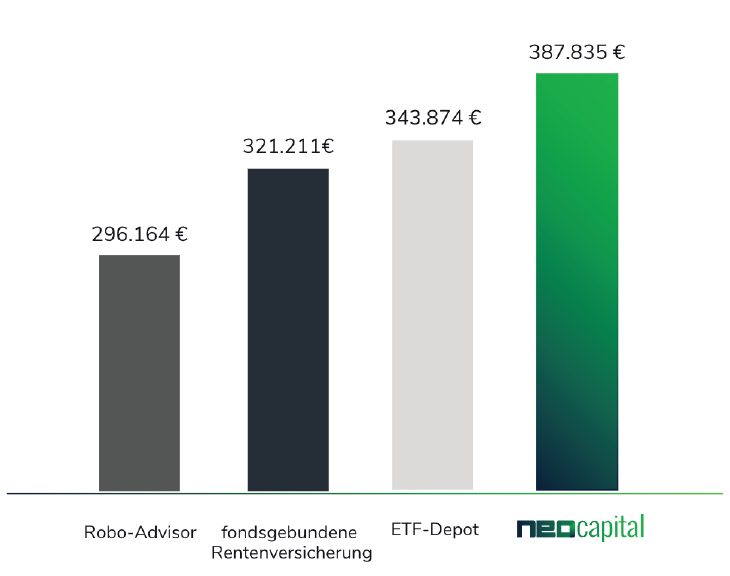
Neo Capital accompanies private individuals on the way to the optimal investment structure as an independent adviser with more than 15 years of experience. Our experts compare possible options actuarially in terms of their return and create a model that can ensure lasting prosperity in old age. In cooperation with your tax adviser, we structure your investment strategy so that refunds and allowances flow back into your personal provision. This enables you to achieve a considerably higher net return compared with the conventional approach.
The importance of retirement planning products
There are various types of retirement planning products that can help us close our pension gap. These products can be divided into state-subsidised and private options. State-subsidised retirement products offer certain advantages and are designed for specific target groups. A well-known example is the Riester pension (Riester-Rente), which is aimed particularly at families or single parents with many children. On the other hand, we have private retirement options that offer more flexibility and return opportunities. These include private pension insurance, ETF savings plans and real estate investments, among others. State-subsidised retirement provision: the Riester pension is a state-subsidised retirement product in Germany that is particularly attractive for families or single parents with many children. Persons directly eligible for Riester subsidies are:
- Compulsory members of the statutory pension insurance scheme (gesetzliche Rentenversicherung)
- Civil servants (Beamtinnen und Beamte)
- Judges
- Soldiers
- Pensioners
In addition, spouses of directly eligible persons can be indirectly subsidised if they take out a Riester contract themselves and pay in at least €60 a year. The Riester pension is subsidised by a retirement savings allowance (Altersvorsorgezulage), consisting of a basic allowance and a child allowance. To receive the full allowance, a minimum contribution of four per cent of the previous year's gross income subject to pension insurance contributions must be paid. Furthermore, contributions to a Riester contract can be claimed for tax purposes as special expenses (Sonderausgaben) up to a maximum amount.
Company pension schemes
Another important pillar of retirement provision is the company pension scheme (betriebliche Altersvorsorge, bAV). In Germany, employees have a legal right to a company pension through salary conversion (Entgeltumwandlung). This means that part of the gross income is paid into a company pension scheme. Contributions to company pension schemes are tax-free up to a certain amount and, up to four per cent of the contribution assessment ceiling (Beitragsbemessungsgrenze), also exempt from social security contributions. Company pension schemes comprise various models such as:
- Direct pension commitment (Direktzusage)
- Direct insurance (Direktversicherung)
- Pension fund (Pensionskasse)
- Pension fund (Pensionsfonds)
- Support fund (Unterstützungskasse)
With a direct pension commitment, the employer itself forms provisions, whereas the other models involve an external pension provider. These models can be designed as defined benefit or defined contribution schemes, with fixed pension benefits or variable, return-dependent benefits. Particularly when the employer's contribution enables tax advantages and savings on social security contributions, integrating the company pension into your individual retirement strategy makes particular sense. The Company Pensions Strengthening Act (Betriebsrentenstärkungsgesetz) can play an important role in this context, especially in the structuring of retirement contracts.
Private retirement planning concepts
Besides state-subsidised retirement products, there are also a number of private retirement options. One of these is private pension insurance. It provides a lifelong pension and can be financed with single premiums or regular premiums. There are two options: the deferred annuity, with payments beginning later, and the immediate annuity, with payments starting directly after payment of the premium. Another attractive option is ETF savings plans. They enable flexible retirement provision with low costs and increased flexibility. An ETF savings plan can be started from as little as €25 a month and offers the opportunity to invest in the market over the long term and thus benefit from its development. Finally, real estate is also a popular form of private retirement provision. Buying a property can serve to save on rent in the long term and to use the property as an asset in retirement once the loan has been paid off. These and other private retirement options offer flexibility and return opportunities and can help close the pension gap.
Neo Capital: expert advice for ideal retirement planning
Although it is possible to plan and implement your own retirement provision yourself, professional advice can help clarify complex questions and develop a tailor-made strategy. An adviser's experience can help save money by avoiding less worthwhile retirement products and selecting profitable alternatives. Independent advisers can give objective recommendations because they are not tied to particular companies or products. As an expert in this field, Neo Capital specialises in advising on and structuring models for personal retirement provision. We support you in building the optimal structuring model for maximum return in retirement. To this end, we advise you independently and individually on the basis of your life situation, goals and plans for old age. Arrange a no-obligation initial consultation and find out which form of retirement provision is best suited to you.
Frequently asked questions
What are retirement planning products?
Retirement planning products are private provision options such as real estate, shares, private life or pension insurance, as well as state-subsidised products such as the Riester pension or the basic pension (Basis-Rente). They serve long-term wealth building and retirement provision.
Which insurance policies are part of retirement provision?
Retirement provision includes company pension schemes, the Riester pension, the Rürup pension, private pension insurance, life insurance, term life insurance and funeral expenses insurance. It is important to take these different policies into account for comprehensive retirement provision.
Which retirement provision can be deducted from tax?
Under German tax law, taxpayers can deduct the costs of retirement provision serving basic coverage as special expenses. These include, for example, contributions to the statutory pension insurance scheme, to professional pension schemes (berufsständische Versorgungswerke) and to the basic pension — also known as the Rürup pension. In 2024, the maximum amount you can claim as pension expenses in your tax return is €27,566. Of this, 100% is tax-deductible.
What is the Riester pension?
The Riester pension is a state-subsidised retirement product that is attractive for families or single parents with many children, as it offers state allowances and tax advantages.
What is a company pension scheme?
A company pension scheme is a form of retirement provision in which employees pay in part of their gross income, with contributions being exempt from tax and social security contributions up to a certain amount.