
Buying a Rented Flat as an Investment (2024)
This guide refers to German law and the German tax system. It is a translation of our German original and does not replace individual tax or legal advice.
There are many reasons for buying a property, whether as an investment for retirement or for your own immediate use. In recent years, more and more private individuals have decided to invest money in rented flats. Although this trend has been slowed by rising interest rates, experienced advisers still have a selection of flats with attractive returns. We would like to explain what lies behind the purchase decision and how, as a buyer on the road to financial freedom, you can lay the foundation for building your wealth at an early stage. You will also learn which tax-free options are available to you as an investor when selling.
Our financial experts at Neo Capital support private individuals and entrepreneurs in optimally structuring their finances. We also help our clients convert tax liabilities into private wealth, thereby creating new capital for attractive investments. When arranging financing and off-market deals, we advise prospective buyers comprehensively on their individual options. Take advantage of our advice and benefit from rental income from letting your flat as well as numerous tax privileges.
Let property vs. owner-occupied flat
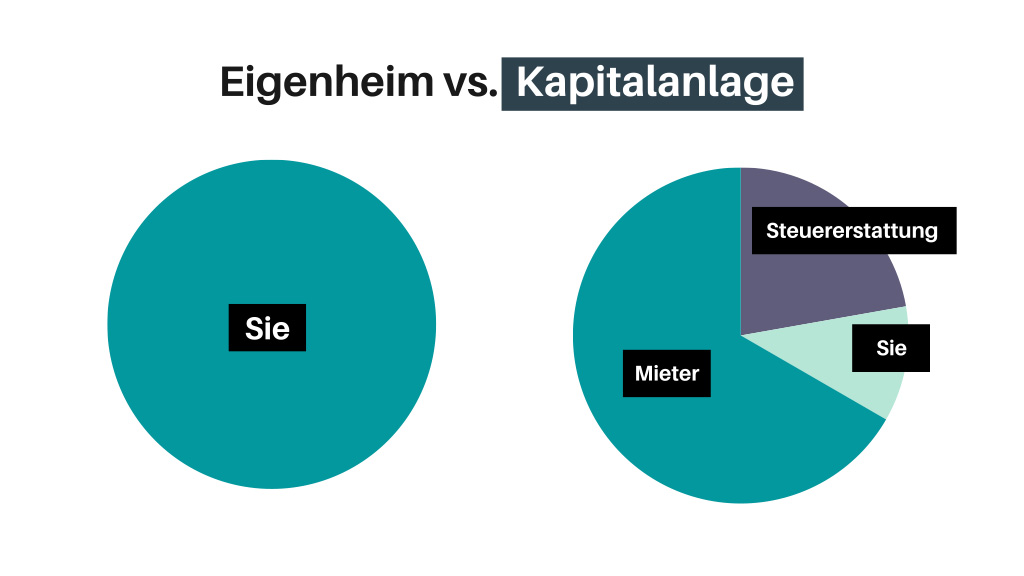
When buying a rented flat, the question arises as to whether you will live in it yourself in future or whether it will remain let. This decision is also important for the bank, as ongoing rental income from a rented flat counts as security for repaying your loan. Herein lies the first advantage of a rented flat: your tenant continuously pays off the majority of your investment. In contrast to a rented flat, an owner-occupied flat can be bought for your own use. However, since this offers no wealth-building or tax advantages, we will continue to focus on the flat with a third-party tenancy. Given that banks favour investment in a rented flat, it is worth taking a look at the financing. This consists of equity and borrowed capital, the latter being provided by the bank as a loan. The bank thus finances your investment, which is known as leverage (Fremdkapitalhebel). This phenomenon is unique across all asset classes and enables investors to build wealth by buying property with other people's money. This tailwind from borrowed capital contributes significantly to being able to deploy a multiple of your own capital in the form of leverage. For example, 10% of the purchase price is often enough to have 90% financed by the bank. Anyone wishing to buy a rented flat should therefore definitely rely on affordable borrowed capital with a view to building wealth.
Criteria for buying a rented flat
Financing stands or falls on a few factors: on a personal level, equity, ongoing income and manageable expenses are the most important criteria. If the selected property is right in terms of purchase price and return, the foundation for building your own wealth has been laid. Unlike an owner-occupied flat or a property for your own use, not every property is suitable for profit-oriented letting. Anyone wishing to secure their investment optimally can finance the loan payments through the rental income. This ensures that private income from conventional sources remains free for new investments. Once enough new equity is available as a result, the cycle begins again with another property. At this point, one speaks of building a real estate portfolio. Continually acquiring new properties increases wealth and gives the owner the opportunity to sell an existing rented flat tax-free and at a profit after 10 years. To buy a rented flat, it is crucial to contribute a certain amount of capital towards the purchase price yourself. For further residential property, this capital can come from the tax-free sale of properties that have increased in value: until then, however, investors need good creditworthiness, ongoing income and around 10% of the purchase price. These values are variable and can be adjusted in total via the absolute purchase price of the property. For this reason, particularly attractive rented flats are often bought through expert intermediaries. These off-market deals cannot be found on the internet but are personally proposed and arranged by financial experts. With a rented flat, investors rely not only on an appreciating commitment of their capital but also on an investment providing passive income in old age and for future generations.
Neo Capital: long-term investments in high-yield properties
The tax privilege of property also makes it the most popular form of investment for private individuals in Germany: being able to buy a rented flat is therefore regarded, from a tax perspective and in the view of financial experts across the board, as a low-risk and high-yield business. Anyone who maintains the tenancy with their tenant over the years can also benefit from rising rents and thus protect their investment against inflation. By comparison, landlord duties are frequently handed over to property managers, which greatly reduces the effective effort involved in owning a property. Anyone who, with correct advice, also opts for the right type of property enjoys special depreciation (Sonderabschreibung) and recovers up to 20% of their investment via their income tax return in the first years after acquisition. As you can see, a rented flat is the most attractive form of investment on several levels. The rent from your flat repays the loan for your investment, while after 10 years absolute tax advantages arise on sale. Depending on location, the purchase price of the flat can also develop strongly, which can be observed particularly with flats in urban areas. We accompany you through the purchase, from the initial consultation to the selection, review and price calculation of your investment. You also benefit from our network of banks for attractive financing and receive independent advice from our financing partners.