
Market Value vs. Tax Value of Inherited Property: Differences, Consequences and Structuring Approaches
This guide refers to German law and the German tax system. It is a translation of our German original and does not replace individual tax or legal advice.
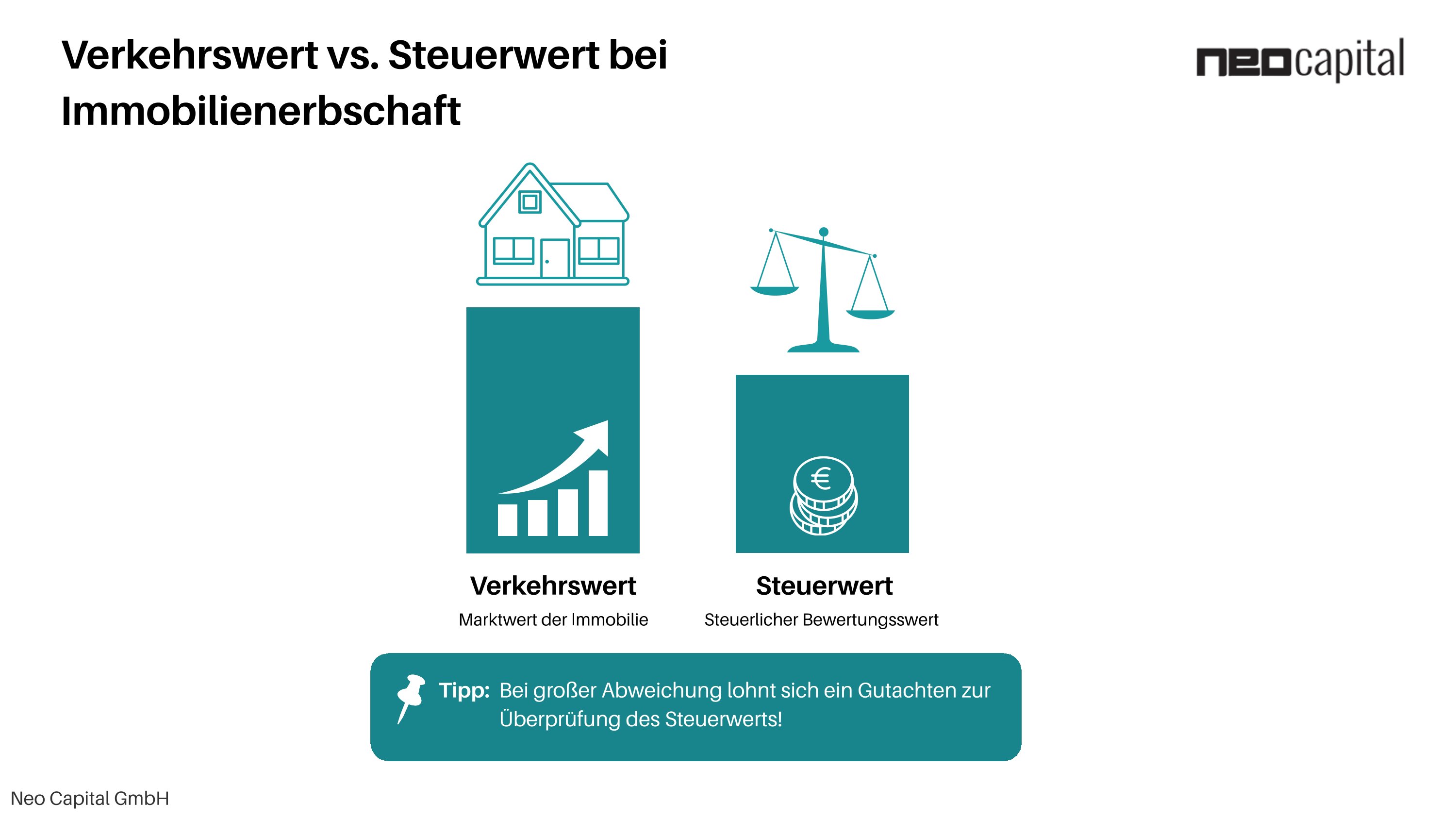
The distinction between market value (Verkehrswert) and tax value (Steuerwert) plays a central role when property is inherited. While the market value reflects the price a property can achieve on the market, the tax value forms the basis for determining inheritance tax (Erbschaftsteuer). The two values follow different valuation logics and have a decisive influence on the tax burden. For wealthy heirs, entrepreneurs and families, it is therefore essential to understand these differences and use them in a targeted way for tax-optimised succession planning. Neo Capital provides clients with comprehensive advice in this sensitive area and, together with specialist tax advisers and notaries, develops individual strategies to secure wealth and minimise tax burdens.
The market value of a property is usually determined by valuation reports, market analyses or the comparative value method. It serves as a guide for purchase, sale or financing decisions and reflects supply and demand on the property market. By contrast, the tax value is calculated in accordance with the provisions of the German Valuation Act (BewG, Bewertungsgesetz). Depending on the valuation method (income capitalisation method, asset value method, comparative value method), it can deviate considerably from the market value. Particularly in the case of let residential properties, there are often discounts that lead to a significantly lower tax value and thus reduce the basis of assessment for inheritance tax.
Valuation methods and tax levers
The Valuation Act specifies how the tax value of properties is to be determined. For owner-occupied properties, the comparative value method (Vergleichswertverfahren) is generally applied; for let properties, the income capitalisation method (Ertragswertverfahren). Owing to the capitalisation of the sustainably achievable income, the latter often leads to a tax value below the current market value. For commercial properties, on the other hand, the asset value method (Sachwertverfahren) applies, which derives the value from construction costs and land value. Neo Capital analyses in detail for clients which valuation method is to be applied in the specific case and identifies structuring options to optimise the tax burden.
The tax discounts provided for under inheritance tax law are of particular relevance. For example, a valuation discount of 10 per cent can be claimed for let residential properties. For properties used for business purposes, further privileges may come into consideration, for instance in the context of business succession. Neo Capital works closely with specialist tax advisers here in order to make consistent use of the available tax levers and achieve the lowest possible tax burden for the heirs.
Consequences for succession planning
The difference between market value and tax value has a considerable impact on strategic succession planning. Properties with a high market value but a favourable tax value can be included in the transfer of wealth in a targeted way in order to make optimal use of allowances. Neo Capital develops individual concepts for this that take into account both the current market situation and the family circumstances. Beyond the mere tax valuation, liquidity planning also plays a role, as inheritance tax must in principle be paid in cash, regardless of the liquidity of the estate.
Another aspect is the optimisation of lifetime gifts. Here, considerable tax savings can be achieved through targeted transfers that make use of the personal allowances and the tax value advantages. In close coordination with notaries and lawyers, Neo Capital supports clients in structuring such advance transfers in order to pass wealth on to the next generation early and efficiently.
Structuring options and strategic advice
Steering the tax value in a targeted way requires early and detailed planning. This includes documenting the current use, optimising the structure of tenancy agreements for let properties and documenting the property valuation in a legally sound manner. Neo Capital works with experienced valuers and tax experts to create a robust valuation basis for clients and to make full use of the scope available for tax purposes.
In addition, Neo Capital advises on complex structures such as contributing properties to family companies, using usufruct (Nießbrauch) or residential rights (Wohnrecht) arrangements, and strategically integrating properties into existing asset structures. These measures can not only reduce the tax burden but also secure long-term wealth preservation and make family succession free of conflict.
Neo Capital as a partner for tax-optimised succession
The distinction between market value and tax value is of decisive importance when property is inherited. Neo Capital offers wealthy private individuals, entrepreneurs and families strategic advice that comprehensively takes into account both the tax and the economic aspects of wealth succession. Through close cooperation with specialist tax advisers, notaries and valuers, Neo Capital develops individual solutions that secure wealth over the long term and minimise tax burdens.
In a legally complex and dynamic environment, Neo Capital thus offers decisive added value: the combination of professional excellence, exclusive market access and strategic planning expertise in order to create and preserve lasting value for clients.