
The Inheritance Process – What Heirs and Testators Need to Know
This guide refers to German law and the German tax system. It is a translation of our German original and does not replace individual tax or legal advice.
An inheritance brings not only emotional challenges but also a wide range of legal and tax obligations. Who inherits if there is no will? How is the estate settled, and which deadlines must be observed? In Germany, the inheritance process follows a clear structure governed by the German Civil Code (BGB, Bürgerliches Gesetzbuch). While many heirs assume that the transfer of assets happens automatically, there are numerous formal steps that must be observed. Without forward-looking estate planning, lengthy disputes and unexpected tax burdens can arise that considerably reduce the value of the inheritance.
For wealthy private individuals, it is particularly important to use tax structuring options early and to make clear arrangements for succession. Neo Capital GmbH provides clients with comprehensive advice on all questions of estate planning. In cooperation with experienced tax advisers and notaries, we develop strategies that ensure a tax-optimised and legally secure transfer of wealth.
Statutory succession and its significance in the event of inheritance
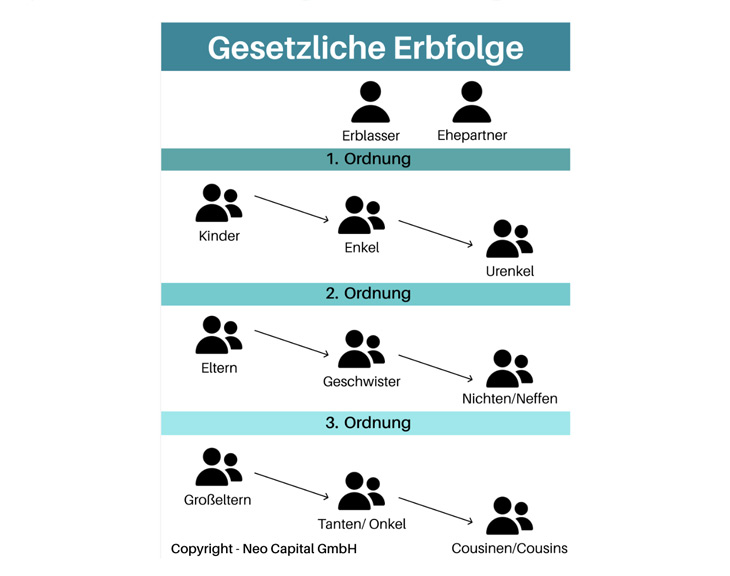
If there is no will or contract of inheritance (Erbvertrag), statutory succession (gesetzliche Erbfolge) automatically applies. This is based on the degree of kinship to the deceased and divides heirs into different orders. First in line are the deceased's descendants, i.e. children, grandchildren and great-grandchildren. If there are no heirs of the first order, the deceased's parents and their descendants enter the line of succession. Only if there are no persons entitled to inherit in this order either do grandparents, aunts, uncles and cousins inherit. Spouses occupy a special position, as their share of the inheritance is determined not by orders but by the matrimonial property regime and the number of surviving relatives.
Statutory succession can be a practical solution for many families, but it also entails risks. If there is no will, unwanted heirs may be included or assets may be distributed in a way that does not reflect the wishes of the deceased. In addition, statutory succession in many cases leads to the formation of communities of heirs (Erbengemeinschaften), which frequently result in disputes and economic disadvantages. Anyone wishing to avoid this should set out an individual inheritance arrangement early on. Neo Capital supports clients in developing tailor-made estate strategies to ensure an efficient and tax-optimised transfer of wealth.
The steps in the inheritance process and important deadlines for heirs
After a death, the formal inheritance process begins with the opening of the will or – if there is none – with the determination of statutory succession. If the deceased has written a will, it is examined by the probate court (Nachlassgericht) and officially announced to the heirs. If there is no will, the statutory provisions are used to determine who qualifies as an heir. Once the succession has been clarified, the heirs must decide whether to accept or disclaim the inheritance. This decision must be made within six weeks of becoming aware of the inheritance. Disclaiming can be sensible if the estate is over-indebted or high tax liabilities are looming.
Once the inheritance has been accepted, the next step is to apply for a certificate of inheritance (Erbschein), which serves as proof of entitlement to inherit vis-à-vis banks, authorities and contractual partners. If there is a notarised will, the certificate of inheritance can be dispensed with in many cases. The estate is then divided. If there are several heirs, they initially form a community of heirs that manages the estate jointly. Reaching agreement on the distribution of the inheritance is often complicated and requires a clear succession strategy. Professional estate planning can avoid conflicts here at an early stage.
As soon as the assets have been transferred to the heirs, the inheritance must be reported to the tax office (Finanzamt). Heirs are obliged to submit an inheritance tax return within three months of the inheritance. The amount of inheritance tax (Erbschaftsteuer) depends on the tax class, the inheritance tax allowance and the value of the inherited assets. As the tax burden can vary considerably, early planning is essential. Neo Capital advises clients on the best strategies for minimising inheritance tax and securing wealth over the long term.
Tax structuring of an inheritance and possible tax optimisation
Inheritance tax can represent a considerable financial burden, particularly in the case of property or business holdings. To reduce this tax burden, there are various structuring options that should be used early on. One of the most effective methods is to use the allowances, which vary in amount depending on the degree of kinship. Children have a tax-free allowance of €400,000 per parent, while spouses can inherit up to €500,000 tax-free. In addition to using allowances, gifting assets during one's lifetime can also be a sensible measure. Through staggered transfers within the ten-year period, substantial assets can be passed on to the next generation tax-free. The reservation of usufruct (Nießbrauchvorbehalt) also offers tax advantages, as it reduces the taxable value of a property and the gift can thus be kept within the allowances.
For entrepreneurs, the tax-free transfer of business assets (Betriebsvermögen) is particularly relevant. Under certain conditions, businesses can be passed on to the next generation completely tax-free, provided the business is continued for a minimum period of five to seven years. If these rules are not used, inheritance tax can quickly become a considerable financial burden for the business. Together with tax experts, Neo Capital develops tailor-made concepts for transferring assets in a tax-optimised way.
Future developments and possible legislative changes in inheritance law
Inheritance tax law is revised regularly, and it cannot be ruled out that future reforms will restrict existing tax privileges. Stricter rules could be introduced, particularly for large inheritances and business successions. A possible increase in inheritance tax or a reduction in the allowances would primarily affect wealthy families and entrepreneurs.
In addition to tax aspects, inheritance law rules are also changing. Statutory succession could be regulated more strictly in future in order to extend compulsory portion claims (Pflichtteilsansprüche) or to dissolve communities of heirs more efficiently. However, those who address estate planning early can create a solution for the transfer of wealth that is secure in the long term, regardless of legislative changes.
Neo Capital keeps clients continuously informed about current legislative changes and helps adapt existing inheritance strategies to new legal frameworks.
Conclusion: plan the inheritance process early and avoid tax pitfalls
Settling an inheritance is a complex process that brings both legal and tax challenges. Without strategic planning, unexpected tax burdens or disputes within the community of heirs can quickly arise. Arranging the estate early ensures that wealth is transferred in line with individual wishes and that tax structuring options are used optimally.
Neo Capital GmbH supports clients throughout the entire inheritance process – from determining the line of succession to tax optimisation. In cooperation with tax advisers and notaries, we develop tailor-made solutions that not only give heirs financial security but also preserve wealth over the long term. Contact us for individual advice and find out how you can arrange your inheritance efficiently.