
Avoiding Premature Real Estate Transfer Tax – Structuring Options for Communities of Heirs
This guide refers to German law and the German tax system. It is a translation of our German original and does not replace individual tax or legal advice.
Transferring property within a community of heirs (Erbengemeinschaft) raises not only legal but also tax questions. A frequently overlooked pitfall is real estate transfer tax (Grunderwerbsteuer): while the direct acquisition of a property through inheritance remains exempt from real estate transfer tax (Section 3 No. 2 of the German Real Estate Transfer Tax Act, GrEStG), later transfers within the community of heirs or its dissolution may well give rise to a tax liability – often with unexpectedly high financial consequences.
Particularly in the case of substantial estates involving several heirs, the tax aspect is often considered too late. Yet there are structuring options for avoiding so-called "premature" real estate transfer tax. Neo Capital GmbH supports clients in such cases with legal and tax expertise and, together with notaries and tax advisers, develops individual estate solutions that optimally combine both family and tax interests.
When is real estate transfer tax a risk within a community of heirs?
The direct acquisition of a property by inheritance is exempt from real estate transfer tax. It becomes problematic, however, when a property is divided within the community of heirs or removed from it – for instance, when one heir takes over all the shares and the co-heirs are paid out. In such cases, the tax office (Finanzamt) regularly sees a taxable acquisition.
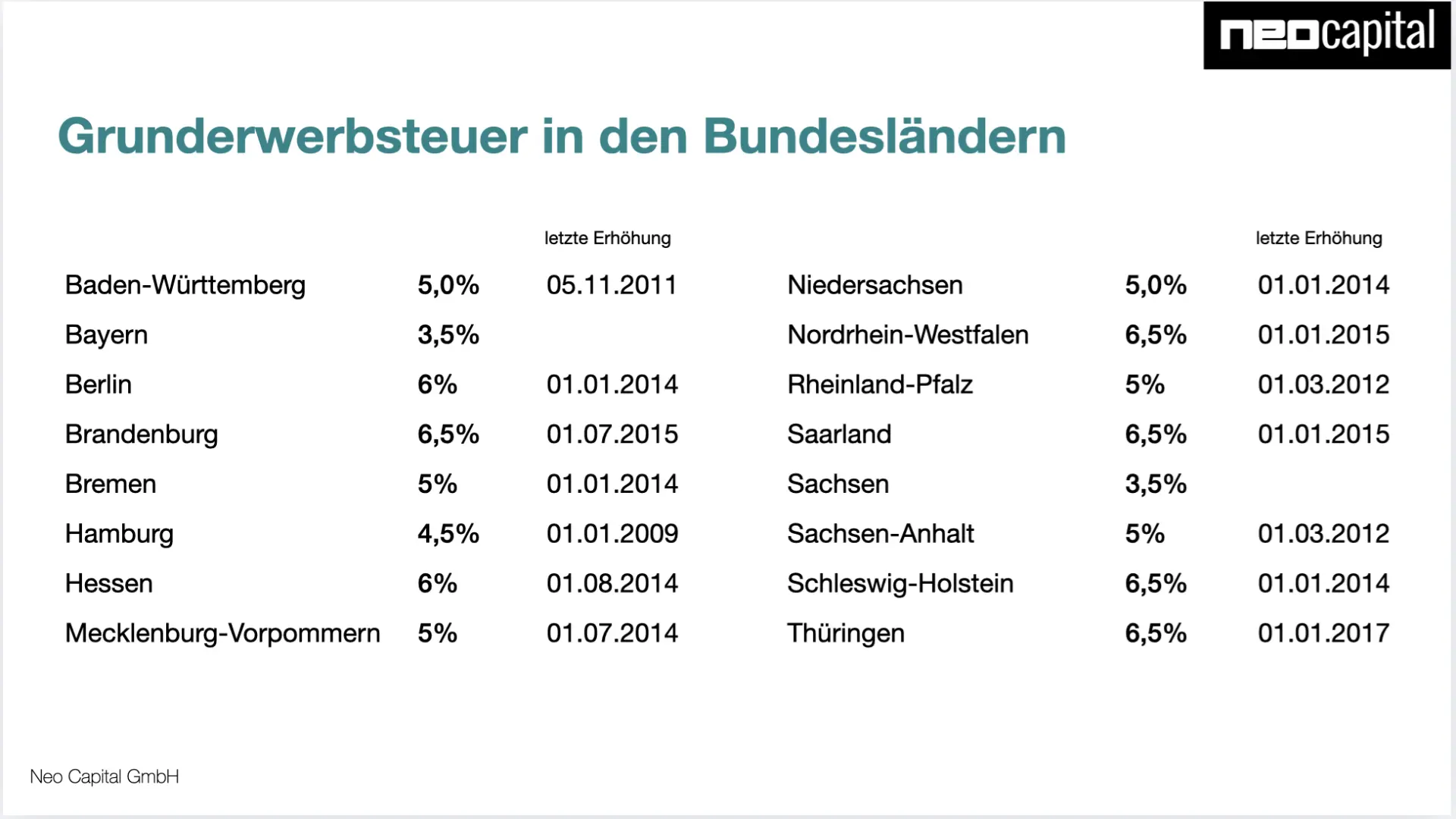
Example: three siblings jointly inherit a let property. One of them wants to take over the property alone and pays out the other two. As this payout is treated economically like a purchase, real estate transfer tax is due on the share taken over – depending on the federal state, up to 6.5% of the value of the shares. The tax burden can therefore quickly reach five-figure sums, even though the property comes from the family estate.
The same applies to a partial division of the estate, for example when a property is allocated to one heir and other assets to the remaining heirs. As soon as the value of the allocation exceeds the notional share of the inheritance or payments are made, this can lead to a proportionate tax liability.
Strategies for avoiding provisional real estate transfer tax.
Those who start at the estate planning stage can avoid these tax burdens in a targeted way. One of the most effective measures is to transfer the property during one's lifetime – for example by way of a gift with reservation of usufruct (Nießbrauchvorbehalt). This clearly separates the acquisition from the inheritance, and it is subject to the more generous rules of gift tax (Schenkungsteuer), with high allowances and no real estate transfer tax.
Another option is to divide the community of heirs without a compensation payment. If a property is transferred to a co-heir solely in exchange for their notional share of the inheritance – without any additional payment – this transaction remains exempt from real estate transfer tax according to prevailing tax case law. However, this requires a documented and unambiguous contractual arrangement.
Setting up a family company can also make sense: instead of transferring the property to individual heirs, it is contributed to an asset-managing company in which all heirs hold shares according to their quota. This simplifies later transfers of shares, and the property remains in the company on a tax-neutral basis. Future transfers can then be structured with reference to special company law provisions which, under certain conditions, likewise do not trigger real estate transfer tax.
Neo Capital develops such solutions together with specialist advisers and ensures that legal, family and tax aspects interlock harmoniously. The aim is to preserve wealth and to structure inheritances free of conflict and in a tax-efficient manner.
Conclusion: premature real estate transfer tax can be avoided – with timely planning.
Premature real estate transfer tax in communities of heirs is a frequently overlooked danger, but one that can be avoided through forward-looking structuring. Those who act in good time, for example through lifetime transfers, clear company law structures or a targeted division of the estate, can save considerable tax burdens and secure family assets.
Neo Capital GmbH supports families, heirs and entrepreneurs with strategic estate planning and develops individual concepts for the tax-optimised transfer of property. Together with our network of tax advisers, valuers and notaries, we create clarity in complex constellations – legally secure, tax-efficient and sustainable.
Contact us if you wish to transfer a property within a community of heirs – before tax liabilities arise that could be avoided.
Frequently asked questions
What does "premature real estate transfer tax" mean in a community of heirs?
Premature real estate transfer tax describes the tax burden that can arise when properties are transferred or allocated within a community of heirs – for example through the payout of co-heirs. While the inheritance itself remains tax-free, such a payment is treated like a purchase and is therefore subject to real estate transfer tax.
When is real estate transfer tax payable within a community of heirs?
Whenever an heir receives more than their notional share of the inheritance and makes compensation payments for it. The classic case is a co-heir taking over the property alone and paying out the others.
How high is real estate transfer tax?
Depending on the federal state, the rate varies between 3.5% and 6.5% of the property value or of the share transferred. With high property values, the tax burden can quickly reach five-figure sums.
How can premature real estate transfer tax be avoided?
Lifetime transfer (e.g. by way of a gift with usufruct); division without a compensation payment (transfer exactly in line with the share of the inheritance); family company (contribution of the property and later transfer of shares making use of special tax provisions).
Who can help with the structuring?
Tax advisers, notaries and specialist investment advisers such as Neo Capital GmbH develop individual concepts that are legally secure while minimising the tax burden. Sample calculation: three siblings jointly inherit an apartment building worth €900,000, so each share of the inheritance corresponds to €300,000. If one sibling takes over the building alone and pays out the other two, real estate transfer tax is due on the €600,000 share taken over – at a rate of, for example, 6.0% (Berlin), that is €36,000, even though it is a family property. With forward-looking structuring (e.g. a lifetime transfer or setting up a family company), this tax burden could have been avoided entirely.